May 12, 2006

World Bank Uses Brazil as Funding Benchmark

The World Bank is being flooded with requests by developing nations for funding ethanol projects. According to this report from Reuters, Brazil's sugar cane ethanol economics is used as a benchmark for determining which international projects will get World Bank support.

International deployment of alternative fuel biorefineries will become increasingly important for reducing the economic impact of rising oil prices. The International Energy Agency estimates that, at best, ethanol could make up 10 percent of world gasoline by 2025.

Some excerpts from the report:

--------------------

World Bank "flooded" with ethanol fund requests
Reuters, May 12, 2006

"We've been flooded with requests from lots of countries. There's some requests from Latin America, we've had several from Africa and one or two in East Asia," Marcelo Lessa of the International Finance Corp. (IFC) said from a cane-ethanol mill in Brazil's Sao Paulo state.

Since November, sugar cane project funding requests -- largely in the feasibility stage -- have come in from Mali, Guatemala, Honduras, the Philippines, Colombia, Saint Kitts & Nevis, Mozambique, Tanzania, Egypt and Turkey.

"We'll turn several (plans) down because we believe ethanol production has to be competitive with costs in Brazil; otherwise you might be hurting a country economically," Lessa said.

Projects that are more likely to be approved are in countries with a well-established sugar cane infrastructure such as Colombia, Peru, Mozambique, Angola, Thailand and Australia.

"India's a very large producer. They have efficient mills but they have very high costs because of problems on the agriculture side," such as small farms, he said.

Another benchmark is costs, using Brazilian output costs as the standard. That cost is about $227 per cubic meter, but an 11 percent rise in Brazil's real against the dollar from January to April has made some proposals uncompetitive.


technorati , , , , ,

May 11, 2006

NY Times: "Miles per Cob" - Redefining CAFE Standards

Senator Tom Daschle and venture capitalist Vinod Khosla published an op-ed piece in the NY Times that seeks to improve CAFE standards. Raising a vehicle's MPG doesn't solve the problem of oil dependence - it only prolongs it. They proposed a new CAFE "Carbon Alternative Fuel Equivalent" which is explained in excerpts from the article below.

What is the point of driving 40mpg if those gallons consist of 100% gasoline? From an oil independence standpoint we would be better off driving 40mpg with E85 because we would only be using one gallon of gasoline for every 5 of ethanol. Stated another way, instead of going 400 miles on 10 gallons of gasoline - we would only consume 1.5 gallons - the rest would be ethanol.

Since configuring a new model car to be flex-fuel compatible does not cost anything, and cycling out the nation's cars could take 15 years, we should (like Brazil has) mandate that all new cars - including hybrids - be flex-fuel compatible. That, plus the hefty IRS tax credit for renewable fuel pumps, would encourage gas stations to begin supplying E85. A plug-in hybrid capable of 100mpg would be able to go roughly 450miles per gallon of gasoline if it was running on E85.

Either one of these two measures would drive the cost of gasoline down.

----------------------

Miles per Cob
by Tom Daschle and Vinod Khosla
N.Y. Times - 5/8/06

Our national leadership must promote a market-based shift away from petroleum-based fuels toward renewable fuels produced in America with American technology.

The CAFE standard does nothing to encourage that change. It requires American automakers to build cars and trucks that meet a minimum standard of average mileage traveled per gallon of gasoline. But the current standard for minimum mileage traveled per gallon of gas consumed is both too low and focused on the wrong challenge.

We need to upgrade to a new CAFE: Carbon Alternative Fuel Equivalent. This new CAFE will measure "petroleum mileage" and give automakers incentives and credits for increasing ethanol consumption as a percentage of fuel use of their vehicles, not least by promoting flex-fuel vehicles, which can run on either gasoline or E85 fuel, a blend of 85 percent ethanol and 15 percent gasoline. This approach promises several significant benefits.

First, it could set America free from its dependence on foreign oil.

Second, switching from gasoline to ethanol produced from perennial energy crops like switch grass can slash our carbon dioxide emissions.

Third, it could build on a comparative advantage of American automakers.

And fourth, by encouraging the production of ethanol and new renewable fuel technologies, this new CAFE standard could invigorate rural communities in America's heartland and innovation and research centers along its coasts.


technorati , , , , ,

MSNBC Dateline: Vinod Khosla on Cellulosic Ethanol

On the same evening as the 60 Minutes broadcast on The Ethanol Solution Dateline NBC was running their own story about ethanol from the point of view of Vinod Khosla - the billionaire venture capitalist who co-founded Sun Microsystems.

Below are some excerpts. For the complete interview and supporting videos, click on the linked title below.

-----------------

A simple solution to pain at the pump?
Greener and cheaper, ethanol could fuel rural America — and won't feed Mideast terrorism
This report aired Dateline Sunday, May 7
Stone Phillips, Anchor

Pain at the pump is the price of this country’s addiction to oil. Americans are feeling it intensely—outraged over oil company profits, fearful that another hurricane in the gulf, or a terror attack in the Middle East is all it would take to send prices even higher.

But what if there was one solution to all of this? Something that could solve America’s energy crisis, strengthen our national security, and help save the planet at the same time?

Vinod Khosla: I looked, did my research and found this was brain dead simple to do.

He’s talking about a new generation of ethanol— the fuel made from plants. It’s one fuel he says is just around the corner and will deliver 4 to 10 times the energy of today’s corn ethanol. Khosla knows, because he’s talked to top scientists, visited labs and he’s a bio-medical engineer himself. He believes this new ethanol can replace gasoline and eliminate America’s dependence on foreign oil.

And that’s exactly Khosla’s vision for America— putting new generation ethanol plants next to paper mills, turning their leftovers into fuel. Or even next to orange juice factories, where he says ethanol from peels could replace petroleum.

But that’s only part of it. To really make America an ethanol nation, Khosla says billions of gallons will come from something as common as prairie grass. He says it’ll be much cheaper and deliver 10 times the energy it takes to make it.

As for the expense, Khosla estimates it would cost about $15 to 20 million to offer ethanol pumps at a thousand gas stations in California.

Khosla: We need to make sure that the major oil companies don’t manipulate the price of oil enough to drive ethanol out of business.

Phillips: Do you believe oil companies would deliberately drop the price of oil?

Khosla: Absolutely. A senior executive of a major oil company came up to me and said, “Be careful.” In a very warning tone he said, “Be careful, we can drop the price of gasoline.”


technorati , , , , , ,

May 10, 2006

CALIFORNIA: Greenhouse Gas Legislation for Vehicles


The chart above shows the percentage contributions of each major sector comprising California's global warming emissions. In this state, if you want to affect greenhouse gas emissions, you have to make changes to the exhaust of automobiles.

From the Union of Concerned Scientists:

----------------------

California Regulates Global Warming Emissions from Motor Vehicles
California’s Vehicle Global Warming Law

On July 22, 2002 California Governor Gray Davis signed into law AB 1493 (commonly known as the "Pavley law")—precedent-setting legislation to reduce global warming pollution from motor vehicles.

This bill directs the California Air Resources Board (CARB) to develop and adopt regulations that achieve the maximum feasible and cost-effective reduction of greenhouse gas emissions (GHG) from passenger cars and light trucks sold in California.

Regulations were developed during 2004 through a series of public workshops and hearings, and were adopted by the California Air Resources Board on September 24, 2004. Regulations will apply only to 2009 and later model year vehicles and will require about a 30% reduction of greenhouse gas emissions by 2016.


technorati , , , ,

Renewable Electricity Standards Compared by State

Recognizing the challenge that making a major renewable energy shift is, 20 states have adopted Renewable Electricity Standards (RES) for electricity. These are requirements for states to gradually increase the amount of electricity derived from renewable energy resources. They generally include specific percentage targets to be achieved by a specific date.

----------------------


Clean Energy
from the Union of Concerned Scientists

State leadership has demonstrated that an RES can reduce market barriers and stimulate new markets for renewable energy. Because renewable energy can help meet critical national goals for fuel diversity, price stability, economic development, our environment, and energy security, an RES should play a vital role in America’s national energy policy.

Which States have an RES?

To date, 20 states and Washington D.C. have implemented minimum renewable energy standards.1 On Election Day 2004, Colorado voters passed the first-ever RES ballot initiative requiring the state’s utilities to generate 10 percent of their electricity from renewable energy sources by 2015. Delaware, Hawaii, Maryland, Montana, New York, Pennsylvania, Rhode Island, and Washington D.C. also enacted minimum renewable electricity standards since the beginning of 2004. Eight states enacted an RES as part of legislation that deregulated electricity generation, and 13 states enacted standards outside of utility restructuring. In August 2005, Texas created the second-largest new renewable energy market in the country, behind only California, when the state increased its requirement from 2,880 megawatts (MW) by 2009 to 5,880 MW by 2015. Several other states—including Minnesota, Nevada, New Mexico, New Jersey, and Pennsylvania—have also revisited and increased or accelerated their standards.

-------------------

Some samples (excerpted from the Institute for Local Self-Reliance (ILSR) website):

California
On September 12, 2002, Governor Gray Davis signed a bill (SB 1078) requiring California to generate 20 percent of its electricity from renewable energy no later than 2017. The new law requires sellers of electricity at retail to increase their use of renewable energy by 1 percent per year. In 2005, state regulators expressed a desire to accelerate the timeline and meet the RPS by 2010. The Governor has endorsed this accelerated schedule and has set a goal of achieving a 33 percent RPS by 2020 for the state as a whole. More...

Texas
In July 2005, the Texas Legislature doubled their previous goal for the amount of wind power, solar power and other forms of renewable energy in the state's energy mix. The new portfolio standard calls for the state to obtain 5,880 MW, or about five percent of the state's electricity, from renewable energy by 2015. Of the total, 500 MW must come from renewable energy sources other than wind energy. More...

Nevada
On June 8, 2001, Nevada enacted the country’s most aggressive renewable portfolio standard at the time. The law required that 15 percent of all electricity generated be derived from new renewables by the year 2013. Five percent of the RPS must be from solar energy projects. In June 2005, Nevada raised the requirements of the RPS to 20 percent of sales by 2015. The bill also allows certain energy efficiency measures to qualify for up to one-quarter of the total standard in any particular year. More...

New Mexico
In early March 2004, New Mexico Governor Bill Richardson signed into law a measure (SB 43) that requires investor-owned electric utilities to produce or buy increasing amounts of renewable energy. Renewables must make up 5 percent of the utilities' sales by 2006, and 10 percent by the year 2011. The law leaves a tiny hole that would allow utilities to ignore the new law through a provision for a PRC-established "reasonable cost threshold" beyond which a utility would not be required to add renewable energy to its energy supply portfolio. More...

New York
In September 2004, The New York State Public Service Commission (PSC) adopted a renewable energy portfolio standard that requires 25 percent of the state's electricity to be supplied from renewable energy sources by 2013. The NY RPS will require about 3,700 megawatts (MW) of new renewable fueled electricity projects to come on-line between 2006 and 2013. The NY RPS also requires a portion of the renewables to come from customer-sited generation. More...

Arizona
The Arizona Corporate Commission (ACC) adopted an Environmental Portfolio Standard in 2001 that required utilities to have 1.1 percent of sales from renewables by 2007. The program did not work. A new plan was announced in August 2005. The ACC’s new plan will require utilities to procure 15% of the state’s electricity from renewable resources by 2025. The ACC voted to require that 30% of the EPS requirement be met by local onsite renewables installed by homes and businesses.. More...


technorati , , , ,

Debunking Switchgrass "Rural Legends"

Ever since President Bush said the word "switchgrass" in the State of the Union address, people have been curious about the role this particular feedstock will play in solving the energy crisis. The theory goes that corn is almost a net energy loser because we put as much petroleum energy into plowing, seeding, fertilizing, harvesting, and distilling corn into ethanol as we get out of it. Switchgrass, which grows like a weed natively in parts of the country that are otherwise considered unarable, does not need nearly as much energy input to grow or cultivate with irrigation.

In an article posted on The Oil Drum blog, contributor named "Kyle" wrote a piece about what he considers the "rural legends" about switchgrass, to set the record straight. His main point is that it is NOT substantially cheaper as a feedstock than corn for producing ethanol.

That may be true but it doesn't mean that it shouldn't be considered a feedstock option for ethanol. Read the article to see his response to each "rural legend" - here are a few excerpts:

------------------

Life in a Grass House
by Kyle, contributor to The Oil Drum blog

Switchgrass is a perennial grass native to the great plains, suitable for marginal lands because it grows well with relatively moderate inputs and can effectively protect soil against erosion. So far so good - one of the major attractions to switchgrass is that it is more environmentally friendly than corn....

This is why so many folks are beating their drums over switchgrass - in theory, it can be grown on marginal lands with ethanol yields 3 times that of corn with "minimal inputs." From this description, one gets the sense of legends in the making. Let's take a critical look at some of them.

Legend 1: Switchgrass does not require fertilizer or irrigation (America's strategic imperative: a "Manhattan Project" for energy by Lt. Col. John Amidon).

.........

Legend 2: It is estimated that 15 percent of the North American continent consists of land that is unsuitable for food farming but workable for switchgrass cultivation. If all that land was planted with switchgrass, we could replace every single gallon of gas consumed in the United States with ethanol. (Sam Jaffe, "Independence Way," The Washington Monthly (July/August 2004)).

.........

Legend 3: Switchgrass yields a certain amount now, but in the future, with selective breeding, etc., it will yield much more.

.........

Legend 4: Switchgrass is substantially cheaper as a feedstock than corn for producing ethanol.

.........

What's the moral in all of this? If corn ethanol is marginal on an energy returned on energy invested (EROEI) basis, it is very difficult to argue that biomass grown to make ethanol will be any better. To be blunt, if there are concentrated stocks of waste biomass in place, such as at lumber mills, then biomass ethanol probably makes sense. Otherwise, it appears to be more or less equivalent to corn based ethanol - in other words, a wash.


technorati , , , ,

May 8, 2006

CALIFORNIA: CEC Addresses Clean Cities Congress

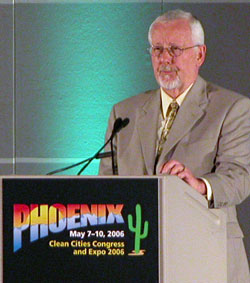
One of my favorite online "hangouts" is the Domestic Fuel Blog, operated by the husband/wife team of Cindy and Chuck Zimmerman. While Cindy writes and posts most of the daily entries, Chuck is traveling from conference to conference, mike in hand, grabbing speakers to give a synopsis of their current message for the attendees. He then publishes the recordings as podcasts on the blog.

This week Chuck is in Phoenix for the Clean Cities Congress and Expo. He caught up with James Boyd who is a member of the California Energy Commission. Mr. Boyd was there to talk about Schwarzenegger's Biofuels Executive Order and to raise expectations for an upcoming CEC action plan to, among other things, develop and deploy cellulosic conversion technologies to help solve fuel and power issues within the state.

You can listen to the podcast by clicking here.


technorati , , , , ,

May 7, 2006

CBS 60 Minutes - The Ethanol Solution - A Review

When you learn that your favorite cause is about to be given a treatment by 60 Minutes you immediately wonder if you should order catering for a wedding - or a wake. After all, "ethanol" has generated a considerable amount of heat over the years. What America needs right now is more light regarding energy issues.

Looks like we'll need extra champagne bottles, the wedding is on. You can access the written transcript of The Ethanol Solution online.

The 60 Minutes broadcast was simple and educational. By highlighting Brazil's success, it provided the best evidence that a significant energy paradigm shift is possible in America. It explained that ethanol is being blended in gasoline and described what E85 is (85% ethanol mixed with 15% gasoline). It showed the personal story of the farming communities who invest their savings to provide employment and have a stake in what many farmers feel is the salvation of their way of life. It showed the ease with which American automobiles can be converted into flex fuel versions that can run on any mixture of gasoline and ethanol. It interviewed General Motors' head Rick Wagoner and reinforced General Motors' Live Green/Go Yellow commitment to aggressively expand the number of the nation's more than 5 million flex-fuel cars.

The only harsh light was cast on the oil industry whose representative, Red Caveney of the American Petroleum Institute, exaggerated the cost of building infrastructure to support E85 ($200,000 per gas station pump). In counterpoint, energy expert Professor Daniel M. Kammen of U.C. Berkeley's Renewable and Appropriate Energy Laboratory (RAEL) contended that switching over to an ethanol infrastructure was far cheaper than Caveney said ($30-$40,000 per pump) and could take a matter of years, not decades.

There were angles that could have been covered.
- If flex-fuel cars don't cost any more than gasoline-only cars, why not legislate that all new cars, including hybrids, be flex-fuel compatible? Brazil did. As the American Petroleum Institute head, Red Cavaney, said "the market is exceptionally limited" because currently only 5 million of the country's 133 million cars can use E85.
- While it did mention the technological prospect of creating ethanol from agricultural waste, switchgrass, and woodchips, it did not give treatment to the emerging technology of converting urban waste to ethanol.
- The story did not mention that the IRS has just published the Alternative Fuel Vehicle Refueling Property Credit, a tax credit of $30,000 for stations installing ethanol pumps. That was announced last week.
- It could have highlighted the environmental benefits of ethanol compared to gasoline.

Overall, it was a very positive story on ethanol and should help legislators and lobbyists to press their legislative initiatives. The tag line, quoted from farmer Larry Meints, said it best:

"It's a win-win thing for the nation, and for our local economy here to create jobs locally, rather than sending the money overseas, and sometimes to people that really don’t like us very well."


technorati , , , ,

May 5, 2006

IRS Publishes Tax Credit for E85 Pumps

Nothing like a crisis to bring partisans together.

This is a good example of how the federal government can help stimulate the movement toward alternative energy - by granting a hefty tax credit for installing alternative fuel dispensing systems at gas stations. This is warranted because there is significant risk to the operators without the credit. States should follow suit.

Thanks to the National Ethanol Vehicle Coalition for applying the pressure needed to keep this provision on the front burner while the 2005 Energy Policy Act was being negotiated.

---------------


E85 Advocates Score Major Victory with IRS
from National Ethanol Vehicle Coalition

Jefferson City , MO - The Internal Revenue Service (IRS) has recently published Form 8911 Alternative Fuel Vehicle Refueling Property Credit which provides the first ever federal income tax credit for the installation of E85 fueling systems.

The infrastructure development provision was part of the 2005 Energy Policy Act and provides a 30% federal income tax credit, up to $30,000 per property, to install alternative fuel dispensing systems.

Phil Lampert, Executive Director of the National Ethanol Vehicle Coalition stated, “The adoption of an infrastructure development credit in the Energy Bill has been the highest priority of the NEVC for the past four years. Additionally, we were concerned with the initial manner in which the IRS interrupted the law, but this final form clearly reflects the intent of the Congress that a vendor with multiple sites be able to utilize the credit at each property being upgraded to dispense E85.”


The new federal income tax credit can also be used by units of government. This can be done by allowing the taxpaying installer to take the credit and indicate to the tax exempt the amount of the credit being provided to offset the total cost of the improvements.

“We believe that this new incentive will provide a significant boost to E85 fueling stations across the country and ease operators’ concerns about the initial cost of the equipment,” added Lampert.

Curtis Donaldson, Chairman of the NEVC stated, “The alternative fuel infrastructure tax credit passed with strong bipartisian support in the Congress last year, but the initial co-sponsors were Senators Jim Talent and Barrak Obama. We are very appreciative of their leadership in promoting this tax credit.”

Donaldson added, “While this new infrastructure tax credit can be used to advance all forms of alternative fuels, we feel that the greatest impact will be to assist our efforts to establish E85 fueling sites.”

The National Ethanol Vehicle Coalition is the nation’s primary advocacy group advancing the use of 85% ethanol as a form of alternative transportation fuel. See www.E85fuel.com for more information.

FRANCE: Converting Woody Biomass into Ethanol

Achieving the dual goals of waste minimization and ethanol production is the objective of a new pilot project collaboration being undertaken in France. Wherever there are forests, paper mills, and logging there will be ample supplies of waste woody biomass that needs to be dealt with. In this scenario, Genencor enzyme technology will be applied to the minimization of milling process residue.

Here are excerpts from a Renewable Energy Access report. A press release from Genecor is also available online.


----------------------

This Week in the Ethanol Business
from Renewable Energy Access

Over in France this week it was announced that Genencor International, a subsidiary of Danisco A/S, will participate in a research consortium to develop economic ethanol production from paper pulp with help from the French forest products industry. The 1.2 million Euros [USD$1.5 million] project will deliver a baseline study of the technical and economic results of a small pilot plant installed at a pulp mill with a focus on waste minimization of the milling process.

"France is one of the leaders in the forest product industry and in related technical applications research," said Jean-Claude Pommier, Executive President of the Strategic Committee at the Institut du Pin -- Universite de Bordeaux. "We believe adding a biorefinery capacity to the paper pulp industry will be a sustainable innovation that will have broad impact."


Genencor will provide its advanced biomass cellulases and application expertise to optimize the enzymatic hydrolysis of various paper-pulp samples provided by Tembec and the Pine Institute. Tembec will analyze the economics to evaluate the system for commercial deployment by the pulp industry. INSA's Laboratory for Biotechnology and Bioprocessing will provide fermentation expertise The Pine Institute will share its expertise in pulping and handling, and in lignocellulose analysis and characterization.


technorati , , , , , , ,

May 3, 2006

BRI Energy - Converting Blended Feedstock into Ethanol

Given a choice of three biomass conversion processes, which is the most promising for greatly expanding the nation's ethanol production?
1) sugar fermentation which only works on sugar crops (like corn kernels and sugar cane);
2) enzymatic hydrolysis which relies on the development of specific enzymes to convert a variety of unblended cellulosic feedstock (like corn stover and switchgrass) into sugars that can then be conventionally fermented into ethanol;
3) syngas fermentation which converts blended or unblended cellulosic feedstock (including all of the above and other crops, plus agricultural, forestry, and urban waste, and even fossil fuels) into ethanol while co-generating electricity.

Bill Bruce, President of BRI Energy, LLC, justifiably contends that the answer is syngas fermentation. Not only would the process' feedstock flexibility greatly increase the volume of biomass available to convert, but decentralized facilities could be used to solve both energy and waste disposal problems for a rural and urban communities alike. For instance, success of Los Angeles' comprehensive landfill diversion program, R.E.N.E.W. L.A., depends on the permitting of six plants using technology like BRI Energy's syngas fermentation process.

Testifying at a Congressional hearing this week, Bruce provided a glimpse of what the potential is for his company's patented processes. Not only that, but he revealed that BRI Energy is working on a developed plan to build two commercial-scale ethanol facilities at the vacant K-31 complex at the Oakridge National Laboratory (ORNL) near Knoxville, Tennessee.

As reported in the Green Car Congress blog May 1st (BRI Energy Seeking to Build Two Gasification-Fermentation Ethanol Plants) the company will begin construction as soon as Department of Energy federal loan guarantees are approved.

The first plant would use gasification to convert Western coal into ethanol. Since gasification operates in a closed environment, no toxic emissions would result from the process.The coal gasification facility would cost $25 million, and the company is seeking a $20-million federal loan guarantee.

The second plant would use blended municipal solid waste (MSW) from Knoxville as the feedstock and convert that as well into ethanol. The municipal waste facility would require $62.5 million in private investment and a $250-million federal loan guarantee.

Both facilities would use the heat in the gasification process to co-generate electricity which would be added to the Tennessee Valley Authority (TVA) grid.

The Knoxville News Sentinel also reported on the announcement in their story titled Company plans big ethanol plant in Oak Ridge. Anticipation of 500 new high quality jobs in a clean, breakthrough technology is good news to their readership.

These innovative commercial-scale deployment projects provide the federal government a crucial role to play toward reduction of our fossil fuel addiction - while reducing landfills, greenhouse gases, and unemployment.


technorati , , , , , , , ,

May 1, 2006

CHINA: The Food vs. Energy Feedstock Conundrum

Asia's growing affluence virtually guarantees that the world's petroleum and natural gas markets will suffer rising prices for the foreseeable future. However, China does not enjoy rich reserves of fossil fuels other than coal so, as reported by Jeff McIntire-Strasburg at sustainablog, China and the rest of Asia is "Looking Hard at Biofuels".

In the 1950's China had a choice between using food for feeding its populace or using it to obtain weapons. Mao opted for power - resulting in the starvation of an estimated 12 million Chinese. It will not sacrifice its people for energy now but the writing is on the wall - it must secure its energy future. According to the following story, China is aggressively pursuing an ethanol production capability using a variety of feedstock. Excerpts are below:

-----------------

Sky-High Oil Prices Fuel Ethanol Mania in China

HONG KONG/BEIJING - Record crude oil prices are fuelling ethanol fever in China, the world's second-largest oil consumer, despite Beijing's reservations in allowing more food grains to be used to run cars.

Beijing is reluctant to expand ethanol production from food grains as China will face a shortage of grains like corn or wheat possibly as early as next year, due to rising domestic demand brought on by higher affluence.

China began its ethanol projects in early 2000 in a bid to get rid of its surplus grain reserves and partially convert them into the biofuel.

China is the world's third-largest ethanol fuel producer after the United States and Brazil, which make the fuel from corn and sugar cane, respectively.

With crude oil prices skyrocketing to more than US$70 a barrel from about US$30 in 2003 when China's ethanol projects started operations, Beijing is likely to scrap subsidies for the four ethanol plants altogether.

But eager investors are unfazed by the prospect.

"Oil prices are so high that it's interesting to make ethanol from most raw materials at the moment," Simon Bentley, an analyst from LMC International Ltd. in Oxford told Reuters.

"With current technology, people start breaking even making ethanol at around US$40 a barrel of oil," said the head of LME's Starch & Sweetener Research, who was in China last week.

Earlier this month, the National Development and Reform Commission, the country's top planner, said on its Web site (www.ndrc.gov.cn.) that biofuels should replace about 2 million tonnes of crude oil by 2010 and 10 million tonnes by 2020.

But it also said China would shift to non-grain raw materials -- such as sweet sorghum or cassava, also known as tapioca -- to make fuel ethanol. These alternatives can be used to churn out around 30 million tonnes of ethanol, the commission said.


technorati

FLORIDA: Citrus as Feedstock - a Farm-to-Fuel Update

Florida has crops and the will of its Farm-to-Fuel Program sponsors to become a leader in the development of an ethanol industry. Florida Agriculture Commissioner Charles Bronson said April 28th:

"I know we can do it. We can have 2 million acres worth of crops for fuel if we can get enough plants built so we can turn it into ethanol. Florida can outproduce any state in the union. Thousands of acres of Florida citrus that were leveled as part of the now-defunct citrus canker eradication program could be put into production for fuel crops."

Below are some excerpts that appeared in a story that contained an interview with Craig Evans, president of Stewardship America Inc. in Boca Raton.

-------------------
Florida Has Future in Alternative Energies
By Kevin Bouffard
The Ledger

A study done earlier this year for the Polk County Farm Bureau suggests the county could land in the center of the alternative-fuel revolution.

"Two technologies . . . are ready for Polk County to use right now," according to a supplement on bio-fuels in the report, "The Contribution of Agribusiness to Polk County, Florida," done by Craig Evans, president of Stewardship America Inc. in Boca Raton.

Evans suggests alternative-fuel technologies using biomass -plant and animal products -could generate a renaissance of profit for Polk's farms and ranches.

Biomass includes not only fruits, vegetables and other foods but waste products such animal manure; grass, weeds, tree limbs and other yard wastes; and tons of citrus peels and pulp from Florida's juice-processing plants.

Until gas prices began heading toward $3 a gallon, ethanol could not compete without federal subsidies. Most ethanol is produced from Midwestern corn.

Even with subsidies, U.S. ethanol production this year will total 3.4 billion gallons, or about 2.3 percent of 145 billion gallons of gasoline consumed annually, Evans said.

How can new technologies change that?

Most ethanol production today comes from a standard fermentation process similar to the production of whiskey and other potable grain alcohols, Evans said.

"Sugar fermentation has, thus far, been the only technology to commercially produce ethanol from biomass, but it is only marginally profitable," Evans said.

Evans supports a new technology called BRI, named for the Arkansas company Bioengineering Resources Inc. that developed it.

The BRI process has an advantage in that it uses not only agricultural products and wastes but anything containing hydrocarbon, such as plastics and tires, Evans said.

"This technology converts any organic waste or hydrocarbon into ethanol," he said. "It also creates low-cost electricity as a byproduct."

That offers the potential to convert garbage now stored in landfills at the cost of millions of dollars to local governments into a valuable product, Evans said.

-----------------

During past energy crises, Americans showed interest in alternative energy, but it faded once the crisis passed.

On April 18, 1977, President Jimmy Carter gave a nationally televised speech on his new energy policy geared toward conservation and developing alternative fuels.

"This difficult effort will be the `moral equivalent of war,' " Carter said.

Critics derisively labeled the policy by the acronym MEOW. Only his proposal for a strategic petroleum reserve became a reality.


technorati

April 30, 2006

April 2006 Digest

This April, the ethanol distribution infrastructure buckled as many oil refiners decided en masse to switch from petroelum-based MTBE additives to ethanol to meet seasonal blend requirements. It was abruptness of this quick demand decision that caused high prices of gasoline as lack of blended product led to shortages in several American east coast states.

When prices topped $3.00 for Regular the hard reality and future implications could not be ignored. Mass transit started looking better and better to consumers while politicians scrambled to appear that they had a "better way" to minimize the problem. They earned a cynical response.

Here is a Digest of articles posted on the BioConversion Blog during the month of April, 2006.
 
------------------------
 
General Topics--------------
• UC/Berkeley Study: Reducing U.S. Oil Dependence
• ACE's State-by- State Ethanol Handbook
• Green Jobs for America: Two Reports
• Visionary Investors Cast Their Eye on Ethanol
• ACORE's Biomass Coordinating Council Workshop (BCC)
• Earth Day 2006 - Clean Energy: Time to Get Practical
• The Next Green Revolution
• U.N.'s FAO to manage International BioEnergy Platform
• FAQ: BioConversion Blog

Vehicle Technology---------------
• Plug-in Partners National PHEV Initiative

Book Reviews--------------
• A Thousand Barrels a Second by Peter Tertzakian
• Mao: The Unknown Story by Jung Chang and Jon Halliday

Around the Nation--------------
• CALIFORNIA: Bioenergy Action Plan - NEVC Recommendations
• CALIFORNIA: Cal/EPA Climate Action Team Report Released
• CALIFORNIA: Are New Taxes a Viable Option?
• CALIFORNIA: Bioenergy Action Plan - Final Released
• CALIFORNIA: Gov. Directs State Agencies to Expand 'Bio-Fuels'
• CALIFORNIA: Gov. Schwarzenegger's Biofuels Executive Order
• FLORIDA: Farm to Fuel Program
• WASHINGTON: Washington State Approves New Biofuels Requirement

Around the World--------------
• U.N.'s FAO to manage International BioEnergy Platform
• China, Ethanol, and the NY Times
• BOOK: Mao: The Unknown Story by Jung Chang and Jon Halliday
• Central America: Biofuel Investment Update
• AFRICA: Growing Biofuel

Worldwide trends for renewable fuel development have never been better. With high gas prices, the motivation and earnings potential are strong. But, as Alex Steffen writes in "The Next Green Revolution" article for Wired magazine, education of some reactionary environmentalists needs to take place. Their strident demonstrations against progressive technological change frustrate investors, labor unions, and local governments and prolong the threatening and toxic status quo.

Noticably frustrated by the slow rate of change is California Governor Arnold Schwarzenegger whose Bioenergy Action Plan has led to enactment of Executive Order S-06-06 which directs state agencies to take major steps toward the widespread use and production of biofuels. We'll keep an eye on how this impacts pending state legislation.


technorati , , , ,

CALIFORNIA: Gov. Schwarzenegger's Biofuels Executive Order

Conversion technologies (CTs) promise to solve both environmental and fossil fuel problems by completing the cycle between waste and energy. With this Executive Order (S-06-06) issued April 25th, Governor Schwarzenegger clearly understands the link. Furthermore, he is ordering his state agencies and commissions to meet specific targets in the production and use of biofuels.

This important message is not getting print space in California newspapers nor other media. Why? As a culture have we become numb to solutions as we stare into the headlights of problems?

I invite other bloggers to comment - and get the word out.

------------------

EXECUTIVE ORDER S-06-06
by the
Governor of the State of California

WHEREAS, abundant biomass resources from agriculture, forestry and urban wastes can be tapped to provide transportation fuels and electricity to satisfy California's fuel and energy needs; and

WHEREAS, ethanol is a renewable transportation biofuel that California consumes more than 900 million gallons a year which is approximately 25 percent of all the ethanol produced in the United States; and

WHEREAS, California produces less than five percent of the ethanol it consumes; and

WHEREAS, biomass fuels, including ethanol produced from cellulose and bio-diesel produced from a variety of sources, can reduce the state's reliance on petroleum fuels and work to lower fuel costs for consumers; and

WHEREAS, in the Hydrogen Highway plan, the state has invested $6.5 million to support a network of more than 16 filling stations and a growing fleet of cars and buses that run on this clean fuel of the future; and

WHEREAS, biofuels can be a clean, renewable source for hydrogen; and

WHEREAS, biofuels offer greenhouse gas reduction benefits; and

WHEREAS, biomass as a source of energy has the potential to power more than three million homes or produce enough fuel to run more than two million automobiles on an annual basis; and

WHEREAS, biomass is a renewable resource which currently contributes two percent of the state's electricity mix, or nearly 1,000 megawatts of the state's generating capacity and is one of the options needed to achieve the State Renewables Portfolio Standard requirements; and

WHEREAS, improvements in the use of waste and residues from forests and farms for energy production can actually decrease the greenhouse gas emissions associated with biomass decomposition that otherwise would occur; and

WHEREAS, harnessing California's biomass resources to produce energy and other products is good for the state's economy and environment and contributes to local job creation; and

WHEREAS, the increased use of biomass resources contributes solutions to California's critical waste disposal and environmental problems, including the risk of catastrophic wild fires, air pollution from open field burning, and greenhouse gas emissions from landfills; and

WHEREAS, sustained biomass development offers strategic energy, economic, social and environmental benefits to California, creating jobs through increased private investment within the state.

NOW, THEREFORE, I, ARNOLD SCHWARZENGGER, Governor of the State of California, by virtue of the power invested in me by the Constitution and the statutes of the State of California, do hereby order effective immediately:

1. The following targets to increase the production and use of bioenergy, including ethanol and bio-diesel fuels made from renewable resources, are established for California:

a. Regarding biofuels, the state produce a minimum of 20 percent of its biofuels within California by 2010, 40 percent by 2020, and 75 percent by 2050;

b. Regarding the use of biomass for electricity, the state meet a 20 percent target within the established state goals for renewable generation for 2010 and 2020; and

2. The Secretary for the California Resources Agency and the Chair of the Energy Resources Conservation and Development Commission ("Energy Commission") shall coordinate oversight of efforts made by state agencies to promote the use of biomass resources; and

3. The Air Resources Board, Energy Commission, California Environmental Protection Agency, California Public Utilities Commission, Department of Food and Agriculture, Department of Forestry and Fire Protection, Department of General Services, Integrated Waste Management Board, and the State Water Resources Control Board shall continue to participate on the Bioenergy Interagency Working Group chaired by the Energy Commission; and

4. The Energy Commission shall coordinate with other responsible state agencies to identify and secure federal and state funding for research, development and demonstration projects to advance the use of biomass resources for electricity generation and biofuels for transportation; and

5. The Energy Commission shall report to the Governor and the State Legislature through its Integrated Energy Policy Report, and biannually thereafter, on progress made in achieving sustainable biomass development in California; and

6. The California Air Resources Board is urged to consider as part of its rulemaking the most flexible possible use of biofuels through its Rulemaking to Update the Predictive Model and Specification for Reformulated Gasoline, while preserving the full environmental benefits of California's Reformulated Gasoline Programs; and

7. The California Public Utilities Commission is requested to initiate a new proceeding or build upon an existing proceeding to encourage sustainable use of biomass and other renewable resources by the state's investor-owned utilities; and

8. As soon as hereafter possible, this Order shall be filed with the Office of the Secretary of State and that widespread publicity and notice be given to this Order.

IN WITNESS WHEREOF I have here unto set my hand and caused the Great Seal of the State of California to be affixed this the twenty-fifth day of April 2006.

Arnold Schwarzenegger

Governor of California


technorati

April 29, 2006

FAQ: BIOconversion Blog


1. What is "BIOconversion"?

I named this blog "bioconversion" because it is a double entendre. The first meaning is quite literally what is in the dictionary - "a process in which a fuel is generated from waste matter, plant matter, etc., as in using bacteria to feed on waste to produce methane." I think bioconversion is the means by which we will be able to not only sustainably create fuel, but also efficiently rid ourselves of accumulating waste..

The second meaning of "BIOconversion" relies on seeing the word as a contraction of "biomass conversion." Biomass includes matter that is not waste - like corn, sugar cane, switchgrass, and other crops. It also includes waste that we don't typically consider to be biologically based - like tires, auto fluff. It can also be blended with fossil fuels, even coal. New processes can convert ALL of these feedstocks into ethanol or hydrogen, while co-generating electricity. The more biomass we recognize as feedstock, the more fuel we can produce.

The second of three biomass processing blogs, this one covers international biomass conversion issues - process R&D, facility deployments, and new developments. The other two related blogs are the BIOstock Blog and the BIOoutput Blog.

2. Why are so many blog entries about California?

I live in California. I have access to people and events in California that I think would interest people around the globe. California is the launching site of so many technological paradigm shifts that I am convinced that either the impetus to change will occur here first, or the shift will mature here before going global - or both. I have immense appreciation for Brazil and American Midwest where much of the bleeding edge R&D and deployment of infrastructure has already taken place.

3. What do I see as the biggest investment opportunity?

Alot of investors visit alternative energy sites including this one. The iron is hot. There are no sure winners right now and many future winners are at a nascent stage of development. From what I have read and what I know cellulosic ethanol produced by syngas fermentation offers the biggest Energy ROI. The feedstock is the cheapest and most varied, it can be blended before gasification, and requires the least amount time and storage to produce.

4. Do I believe in global warming?

I do believe that most industries and utilities are wasteful on a grand scale - particularly in developing nations where environmental standards have been sacrificed to achieve more energy. We have a responsibility to clean up waste and develop more energy-efficient techniques - which is why I am frustrated by environmental Luddites who obstruct attempts to do just that. Clean technologies that can convert waste into energy and useful products are a WIN-WIN for the environmental cause.

I think conversion technologies (CTs) have been proven to provide positive environmental benefits for remedying industrial waste. Any deficiencies in CTs can be corrected and society should have vigilence and patience, not fear, in dealing with unintended effects.

5. What is the significance of a decentralized energy paradigm?

Right now, energy production is centralized to a dangerous extent. Too many resources being managed through too few stable countries, too few refineries distributed among too few locations, and too many managers and politicians who lack principle and foresight. Fortunately, "dinosaurs" give way to "mammals."

Since biomass is plentiful throughout the world and feedstock streams for bioconversion are so varied, each ecosystem and culture could develop unique facilities based on their own natural resources, waste, climate, local demand, and geographic location. The more decentralized the production of energy, the less geopolitical pressure and fear of deprivation throughout the world.

Ethanol cannot be piped like oil can which makes it more important that the source of production is near the source of use.

In short, "fear" of shortage is the primary cause driving up the price of fossil fuels. It is a fear that can be remedied with leadership, patience, and creativity.

6. What needs to happen next in California?

For California to lead the world in developing bioconversion technologies, the state legislature needs to loosen biorefinery permitting restrictions. The executive branch will conduct emissions testing as facilities are deployed. They will halt operations who can't meet environmental regulations, but they must allow them the opportunity to find solutions to comply. Our energy future is best secured with problem solving - not problem avoidance.

The legislature should also enact diversion credits to municipalities that reduce landfill use by recycling unrecyclable waste through conversion facilities.

Pilot and commercial-scale facilities should begin deployment at the earliest possible time. We won't be able to fine-tune conversion technologies and the necessary supporting infrastructure if there are not commercial-scale facilities to process the various feedstock and blends, and test for emissions.

Once proven, investing companies will have new technology to market and help deploy throughout the world.

7. What is the significance of the Rubik's cube imagery on the Blogs?

The Rubik's cube is emblematic of the multi-faceted energy puzzle that confronts civilization. This four blog series is my attempt to create some semblance of order out of the chaos of global interlinking challenges - geopolitics, employment, pollution, energy, waste, carbon emissions, etc. Each Blog is an attempt to work on a side of the puzzle - BIOstock, BIOconversion, BIOoutput, and BIOwaste. Solve these and I believe many international problems will be substantially mitigated.


technorati

April 27, 2006

AFRICA: Growing Biofuel

Thanks to Alternative Source for locating this article on the practical challenges of starting a biofuels facility.

Africa may be the last continent to embrace biofuel conversion technology largescale. But with abundant labor and growing demand for energy, infrastructure, and jobs, it could be the biggest success story.

The article published online by EcoWorld explains the main criteria necessary for starting a biofuels business and goes on to detail a checklist for commercial viability of a jatropha plantation for production of biodiesel.

------------------

Growing Biofuel
A BIODIESEL ENTREPRENEUR'S CHECKLIST FOR ANYONE CONSIDERING ENTERING THIS INFANT INDUSTRY
by Louis Strydom

More than 50% of the vast continent of Africa may support biofuel crops. But success depends on many factors.

This article by biodiesel entrepreneur Louis Strydom, who is endeavoring to establish a biodiesel plantation and refinery on a massive scale in Kenya, serves as a sobering reminder of how many factors have to be aligned before biodiesel fuel moves from dream to reality. Ultimately, biodiesel plantations have to be profitable, and the requirements for success are myriad.

General Criteria for a Viable Biofuel Operation:

• Not Dependent on Subsidies
• Vertical Integration of Farms and Refinery
• Location in Developing Nation
• Large Scale
• Perennial Crop
• Local Market for Biofuel Sales

Louis Strydom is an expert in new venture creation and project finance with wide experience on projects in the developing world. One of Louis' main projects for the last year has been conducting a pre-feasibility study and promotion of a 230,000 acre site for a Jatropha plantation and biodiesel refinery in Kenya.


technorati

April 26, 2006

CALIFORNIA: Gov. Directs State Agencies to Expand 'Bio-Fuels'

California does not grow much corn. What it does have is biomass in other forms - corn stover, other crops, agricultural waste like rice straw, forestry waste, and urban waste including municipal solid waste (MSW) and sewage. So the focus for ethanol production in California - which imports 95% of the ethanol it blends into its gasoline - has NOT been on corn fermentation but on biomass conversion, the key subject of this blog. Conversion technologies (CTs) can turn biomass into clean electricity, heat, and ethanol with virtually zero toxic emissions. Developing these technologies could be the solution to the world's fossil fuel dependence and a boon to California's economy.

Governor Schwarzenegger gets it. Witness his executive order April 25th in response to the relentless price hikes on gasoline in the state and his environmental commitment to reduce pollution and greenhouse gases.

-------------------

Gov. Schwarzenegger Directs State Agencies to Expand 'Bio-Fuels' to Fight High Gas Prices

In line with his strong leadership in reducing California's dependence on petroleum fuels, Governor Schwarzenegger today directed several state agencies to take major steps toward the widespread use of renewable energy sources known as bio-fuels. Biofuels, such as ethanol, can be developed from specially grown crops such as corn and sugar, to produce clean, renewable transportation fuels or electricity. Fuels can also be developed from naturally occurring waste, such as rice straw, animal waste and municipal solid waste.

"It is critical that we do everything we can to reduce our dependence on petroleum-based fuels," said Gov. Schwarzenegger. "Turning waste products into energy is good for the state's economy, local job creation and our environment. By implementing biomass programs in California, we will help fight critical waste disposal and environmental problems, including the risk of wild fires, air pollution from open field burning, and greenhouse gas emissions from landfills."


The Governor issued Executive Order S-06-06 establishing targets for the use and production of biomass products such as biofuels (liquid) and biogas (gas) as an integral part of California's renewable portfolio standard. To achieve these targets, he directed the California Energy Commission (CEC), the Resources Agency and other state agencies to collaborate, research, promote and identify funding to advance biomass programs in California. The CEC will report the progress to the Governor's Office and Legislature on a biannual basis.

California will produce a minimum of twenty percent of its own biofuels by 2010 and forty percent by 2020, according to targets set by the executive order. Currently, of the 900 million gallons of ethanol consumed in California (which is 25 percent of the entire nation's consumption), only five percent is produced in California.

The executive order also calls for the use of biomass for electricity to reach 20 percent within the state's Renewables Portfolio Standard (RPS) goals for 2010 and 2020.

Under Gov. Schwarzenegger's leadership, California has continued to champion policies that reduce the state's dependence on petroleum. To promote the transition to alternative fuels, the Governor led the effort to create the hydrogen highway which will provide Californians with 200 hydrogen fueling stations across the state.


technorati

April 25, 2006

U.N.'s FAO to manage International BioEnergy Platform

As new biomass conversion and fermentation technologies are developed, deployment will depend on assessments of the resources and supporting infrastructure of various sites to support them - and to be supported by them.

Fortunately, the United Nations' Food and Agriculture Organization is anticipating the demand for biofuels well into the 21st Century. On May 9th, 2006 it is inaugurating the International BioEnergy Platform (IBEP), a new agency to coordinate bioenergy information and support throughout the global community. Excerpts from their publicity release is below:

---------------------

U.N.'s Food and Agriculture Organization (FAO) sees major shift to bioenergy
Pressure building for switch to biofuels

Under the pressure of soaring oil prices and growing environmental constraints, momentum is gathering for a major international switch from fossil fuels to renewable bioenergy, according to FAO.

“The gradual move away from oil has begun. Over the next 15 to 20 years we may see biofuels providing a full 25 percent of the world’s energy needs,” Alexander Müller, the new Assistant Director-General for the Sustainable Development Department of FAO said here.


FAO’s interest in bioenergy stems from the positive impact that energy crops are expected to have on rural economies and from the opportunity offered countries to diversify their energy sources. “At the very least it could mean a new lease of life for commodities like sugar whose international prices have plummeted,” noted Gustavo Best, FAO’s Senior Energy Coordinator.

One hazard, for instance, is that large-scale promotion of bioenergy relying on intensive cash-crop monocultures could see the sector dominated by a few agri-energy giants – without any significant gains for small farmers. But to date no comprehensive attempt has been made to address the complex technical, policy and institutional problems involved.

Bioenergy Platform

In order to fill this gap FAO has set up an International Bioenergy Platform (IBEP), to be officially presented at the United Nations in New York on May 9. The IBEP will provide expertise and advice for governments and private operators to formulate bioenergy policies and strategies. It will also help them develop the tools to quantify bioenergy resources and implications for sustainable development on a country-by-country basis.

It will further assist in the formulation of national bioenergy programmes, drawing on FAO’s experience in promoting national, regional and global bioenergy development.

“The aim is to help us grow both enough fuel and enough food,” Müller said, “and make sure that everyone benefits in the process.”


technorati , ,

The Next Green Revolution

Flinty Catherine Mulholland, author of the biography of William Mulholland - the water "czar" who brought water to Southern California in the early 20th century - was asked to comment on her famous grandfather's many critics. Her response:

"They take baths don't they?"

The same could be said of many (not all) environmental activists who use modern technology to organize cross-state rallys to raise their Luddite complaints to block innovative, green business ventures. How do they think this civilization came to provide them with utilities like cellphones, plumbing, electricity, transportation, and the internet?

This article, which appears in Wired Magazine (May 2006) takes this theme and applies it to the changing face of environmentalism. The Green Revolution must rise above NIMBYism and communal provincialism and recognize the stakes inherent in the status quo - pollution, global warming, blackouts, and foreign wars.

------------------------

The Next Green Revolution:
How technology is leading environmentalism out of the anti-business, anti-consumer wilderness.
By Alex Nikolai Steffen

For decades, environmentalists have warned of a coming climate crisis.

Green-minded activists failed to move the broader public not because they were wrong about the problems, but because the solutions they offered were unappealing to most people. They called for tightening belts and curbing appetites, turning down the thermostat and living lower on the food chain. They rejected technology, business, and prosperity in favor of returning to a simpler way of life. No wonder the movement got so little traction. Asking people in the world's wealthiest, most advanced societies to turn their backs on the very forces that drove such abundance is naive at best.

Americans trash the planet not because we're evil, but because the industrial systems we've devised leave no other choice. Our ranch houses and high-rises, factories and farms, freeways and power plants were conceived before we had a clue how the planet works. They're primitive inventions designed by people who didn't fully grasp the consequences of their actions.

You don't change the world by hiding in the woods, wearing a hair shirt, or buying indulgences in the form of save the earth bumper stickers. You do it by articulating a vision for the future and pursuing it with all the ingenuity humanity can muster. Indeed, being green at the start of the 21st century requires a wholehearted commitment to upgrading civilization. Four key principles can guide the way:

  • Renewable energy is plentiful energy.

  • Efficiency creates value.

  • Cities beat suburbs.

  • Quality is wealth.


  • It may seem impossibly far away, but on days when the smog blows off, you can already see it: a society built on radically green design, sustainable energy, and closed-loop cities; a civilization afloat on a cloud of efficient, nontoxic, recyclable technology. That's a future we can live with.


    technorati