Showing posts with label Europe. Show all posts

May 21, 2007

U.S. D.O.E./E.I.A. International Energy Outlook 2007

Business Energy Reports publishes a prolific number of excellent research reports that address the "global energy industry" and are available online for purchase. Did I mention that they are pricey? Well they are and it would serve them well to offer a discount based on volume purchases. Still, if you are curious to see one, they do offer a free loss leader called "Market Survey of the Energy Industry" which you receive online if you sign up for their email announcements of new releases.

Occasionally they distribute press releases that announce new reports from other agencies that are available online. This week they featured the U.S. Department of Energy's latest International Energy Outlook 2007 which is published through the Energy Information Administration (EIA) website (see below).

----------------------------
P R E S S   R E L E A S E

For Immediate Release
Press Contact: Barbara Drazga
Press@EnergyBusinessReports.com
Tel: 800-304-0345
www.energybusinessreports.com


World Energy Use Projected to Grow 57 Percent between 2004 and 2030

Phoenix, AZ –May 21, 2007 – World marketed energy consumption is projected to grow by 57 percent  between 2004 and 2030, according to the reference case projection from the International Energy Outlook 2007 (IEO2007) released today by the Energy Information Administration (EIA). The IEO2007 shows the most rapid growth in energy demand for nations outside the Organization for Economic Cooperation and Development (OECD) especially in non-OECD Asia, where strong projected economic growth drives the increase in energy use.
 
Global energy demand grows despite the relatively high world oil and natural gas prices in the reference case. However, rising oil prices dampen growth in demand for petroleum and other liquids fuels after 2015 and, as a result, reducing their share of overall energy use from 38 percent in 2004 to a projected 34 percent in 2030.  In contrast, the energy shares of natural gas, coal, and renewable energy sources are expected to grow over this period.  Liquids consumption is still expected to grow strongly, however, reaching 118 million barrels per day in 2030. The United States, China, and India together account for nearly half of the projected growth in world liquids use.
 
To meet the increment in world liquids demand in the IEO2007 reference case, supply in 2030 is projected to be 35 million barrels oil equivalent per day higher than the 2004 level of 83 million barrels per day.  Conventional resources account for about 27 million barrels per day of this increase, with a projected 21 million barrels per day increase in production by members of the Organization of Petroleum Exporting Countries (OPEC) and a 6 million barrels per day increase in non-OPEC countries.  Production from unconventional resources (including biofuels, coal-to-liquids, and gas-to-liquids) increases by nearly 8 million barrels per day and accounts for 9 percent of total world liquids supply in 2030.
 
View Details on Related Reports:
Unconventional Gas Outlook: Resources, Economics, and Technologies 2007
Biomass to Biofuels Market Potential 2007
Commercialization of Coal to Liquids Technology 2007
Gas to Liquids Technology and Market Potential
 
Other EIA report highlights include:
 
* Coal consumption, which grows an average annual rate of 2.2 percent, is the fastest-growing energy source worldwide in the IEO2007 reference case projection, which assumes that existing laws and policies remain in effect through 2030 notwithstanding concerns related to the rising level of energy-related greenhouse gas emissions. World coal consumption increased sharply from 2003 to 2004, largely because of a 17-percent increase-on a British thermal unit (Btu) basis-in non-OECD Asia (mainly China and India). With oil and natural gas prices expected to continue rising, coal is an attractive fuel for nations with access to ample coal resources, especially in coal-rich countries like China, India, and the United States. These three countries combined account for 86 percent of the increment in world coal demand by 2030 in the reference case projection.
 
* Higher fossil fuel prices, energy security concerns, improved reactor designs, and environmental considerations are expected to improve prospects for nuclear power capacity in many parts of the world, and a number of countries are expected to build new nuclear power plants. World nuclear capacity is projected to rise from 368 gigawatts in 2004 to 481 gigawatts in 2030.  Declines in nuclear capacity are projected only in OECD Europe, where several countries (including Germany and Belgium) have either plans or mandates to phase out nuclear power, and where some old reactors are expected to be retired and not replaced.
 
* In the IEO2007 reference case, which does not include specific policies to limit greenhouse gas emissions, energy-related carbon dioxide emissions are projected to rise from 26.9 billion metric tons in 2004 to 33.9 billion metric tons in 2015 and 42.9 billion metric tons in 2030. From 2003 to 2004, carbon dioxide emissions from the non-OECD countries grew by almost 10 percent, while emissions in the OECD countries grew by less than 2 percent.  The result of the large increase in non-OECD emissions was that 2004 marked the first time in history that emissions from the non-OECD exceeded those from the OECD countries.  Further, because of the expectation that non-OECD countries will rely on fossil fuels to supply much of their future energy demand growth, carbon dioxide emissions from the non-OECD countries in 2030 are projected to exceed those from the OECD by 57 percent.
 
technorati , , , , decentralization,

February 16, 2007

Online game is a Climate Challenge

The BBC Weather Centre has a wealth of information on their Climate Change website about global warming - evidence, impacts, adaptation, policies, and links. They recently ran a Climate Change experiment that utilized the spare computing power of a quarter of a million participants - mostly throughout Europe and the eastern U.S. Through this huge distributed processing project, thousands of climate change models could be run and the results computed. Their findings:

• The UK should expect a 4°C rise in temperature by 2080 according to the most likely results of the experiment.
• Heatwaves are on the rise and, by 2080, summer temperatures of 40°C will be common. Winters will also be warmer.
• Summer rainfall is set to decrease and the UK can expect more frequent droughts
• Winters will bring less snow and more rain, especially in the north and west. Storms will be more frequent and more severe.
• Different regions around the world can expect varying levels of warming. New Zealand faces a smaller temperature rise than the UK's 4°C change, while Alaska should prepare for a greater increase

They recently published a free, online serious game that simulates the decision-making process engaged by world leaders in counter-acting the global warming phenomenon. It is important that each stakeholder of the energy/environment dialog recognize the need for coordination of many nations efforts to forestall the effects threatened by interlinked future challenges.

Thanks to our European friends at Biopact for supplying the base information on this story. Monitoring bioenergy stories from their well-researched viewpoint should be a part of the regimen for anyone that is serious about global approaches to solving the energy/environmental challenges before us. A monthly digest of their most relevant stories are published here - see February's digest.


----------------
Why make a game about climate change?

The BBC decided a game might be a good introductory route into climate change and some of the issues this creates for governments around the world. At times it was necessary to strike a compromise between strict scientific accuracy and playability. For this reason, Climate Challenge should not be taken as a serious climate change prediction. Wherever possible, real research has been incorporated into the game.

Apart from the primary goal of creating a fun game, Climate Challenge's producers aimed to:
• give an understanding of some of the causes of climate change, particularly those related to carbon dioxide emissions.
• give players an awareness of some of the policy options available to governments.
• give a sense of the challenges facing international climate change negotiators.

Players must respond to catastrophic events caused by climate change as well as natural and manmade events, which may or may not be linked to climate change. This aspect of the game is meant to give some idea of what could happen as the Earth's climate changes and also introduce the unpredictable nature of some natural events.


technorati , , , , , decentralization,

January 14, 2007

Europe's "New Industrial Revolution"

If we are learning anything in the new millennium it is that the Industrial Revolution of the last 150 years is overdue for a major upgrade. While we have come a long way from wood burning boilers (at least in some industries) we seem stuck on old ways of thinking about what is efficient and economical without considering the social costs related to:
1 - particulate matter and toxic emissions from combustion
2 - wasted energy related to released heat and emissions
3 - energy transport and transmission from over centralization
4 - foreign resource and energy supply dependency
5 - carbon release into the atmosphere
6 - geopolitical and market competitiveness
7 - aging infrastructure

We need to look at feedstock and energy generation with a fresh eye - an eye for opportunities to improve the status quo in significant ways. The new European Union report entitled An Energy Policy for Europe gives a glimpse of what is under consideration for that continent with significant implications for the rest of the world.

To see other related European Union documents (plus laymen's summaries), visit the EU Press Room's Energy for a Changing World. Topics include: Renewable Energy Road Map, Progress in renewable electricity, Progress in Biofuels, Gas and Electricity Infrastructures, Nuclear Energy, Sustainable Power Generation from Fossil Fuels, and European strategic energy technology plan.

Below are some excerpts from the Biopact description of the Energy Policy's contents...

-------------------------
EU unveils energy policy for the 21st century: towards a 'low carbon economy' with renewables

Today, the Commission put forward a series of energy reports and policy proposals, which it hopes will be a catalyst for "a new industrial revolution" that will "transform Europe into a highly energy-efficient and low-CO2 energy economy" by the mid-century.

To address those challenges, the Commission proposes an Action Plan, to be implemented in the next three years. It calls on the European Parliament and on EU leaders to endorse the plan at the forthcoming summit in March. "The point of departure for a common energy policy must be combating climate change, promoting jobs and growth and limiting the EU's external vulnerability to imported hydrocarbons," the Commission says.

The new EU energy strategy is based on three main pillars:

1. Accelerating the shift to low carbon energy

In its report entitled the Renewables Energy Roadmap the Commission proposes to maintain the EU's position as a world leader in renewable energy, by proposing a binding target of 20% of its overall energy mix will be sourced from renewable energy by 2020. This will require a massive growth in all three renewable energy sectors: electricity, biofuels and heating and cooling. This renewables target will be supplemented by a minimum target for biofuels of 10%. In addition, a 2007 renewables legislative package will include specific measures to facilitate the market penetration of both biofuels and heating and cooling.

2. Creation of a true Internal Energy Market
The aim is to give real choice for EU energy users, whether citizens or businesses, and to trigger the huge investments needed in energy, as outlined in the policy proposal Prospects for the Internal Gas and Electricity Market. The single market is good not just for competitiveness, but also sustainability and security.

3. Energy efficiency
As outlined in the Strategic Energy Technology Plan [*.pdf], the Commission proposes that the use of fuel efficient vehicles for transport is accelerated; tougher standards and better labelling on appliances; improved energy performance of the EU's existing buildings and improved efficiency of heat and electricity generation, transmission and distribution. The Commission also proposes a new international agreement on energy efficiency.


The European Union cannot achieve its energy and climate change objectives on its own. It needs to work with both developed and developing countries and energy consumers and producers. The European Union will develop effective solidarity mechanisms to deal with any energy supply crisis and actively develop a common external energy policy to increasingly "speak with one voice" with third countries. It will endeavour to develop real energy partnerships with suppliers based on transparency, predictability and reciprocity.


technorati , , , , , , ,

January 13, 2007

Low heat gasification technique to convert biostock to energy

The thermal process of gasification is one way to break down the bonds of cellulosic feedstock into syngas (primarily CO and H2). Some processes, like plasma arc, uses extremely high heat to "vaporize" the biostock.

Here is an announcement from Germany about a company that has been getting very promising results from gasifying at a lower heat level. They claim, based on experiments with woody biomass, that the lower heat level enables the process to be applicable to a greater range of biostock, including wet forestry waste.

While commercial-scalability is always an issue, such advancements bring the vision of decentralized, blended feedstock, continuous flow bioconversion ever closer.

Here is a brief of the original article I found at Biopact. Thank goodness someone there can interpret German!

----------------
German consortium tests new biomass gasification technology, obtains record hydrogen yield

The 'Zentrum für Sonnenenergie- und Wasserstoff-Forschung' (ZSW) in Baden-Württemberg, Germany, announces that it has developed a new gasification technology for the production of an energy rich gas from biomass that can be used for the generation of electricy and heat, but also for the production of biohydrogen, biomethane and a series of next-generation synthetic liquid biofuels.

The innovation at the ZSW concentrates on the water vapour gasification of biomass in the presence of a CO2 absorbent. The technology is based on an innovative step in a process called 'Absorption Enhanced Reforming' (AER), which was developed in cooperation with the University of Stuttgart and other European partners. During the gasification process, solid biomass is converted into a hydrogen-rich and carbon-oxide-poor fuel gas with a low tar content by means of integrated gas conditioning. Compared to other gasification processes, the AER technique yields gas with a much higher hydrogen content; pilot tests showed yields of up to 70% hydrogen, an unprecedented level.

The integrated gasification-cogeneration plant uses woody biomass as a feedstock. But, compared to conventional gasification methods, the AER technique considerably reduces the temperatures required for the gasification of biomass. This not only reduces the amount of energy needed to drive the process, it also allows for a much broader range of feedstocks to be used, including wet biomass. Large waste-streams from the agroforestry industry now become available: from grass and straw residues with low ash melting points, which weren't useable until now, to wet wood (leaves, shoots).


technorati , , , , , ,

October 13, 2006

L.A. and U.K. Discuss Sustainable Energy

Los Angeles (October 13, 2006): Last July, two "heads of state," British Prime Minister Tony Blair and California Governor Arnold Schwarzenegger, met in Long Beach, California to discuss global warming, energy technology, and other environmental issues. As a direct followup, the Foreign and Commonwealth Office of the United Kingdom hosted an "International Sustainable Energy Symposium" on the UCLA campus. The purpose: to provide an opportunity for academics, technologists, and policy makers from both sides of the Atlantic to share notes (and business cards) on a broad range of issues involving sustainable energy and climate change.

Why conduct the symposium?
Bob Peirce, the British Consul General at Los Angeles stressed the commonality and mutual respect that the U.K. and U.S. have for each other on the subjects of energy and air quality. He reminded the audience that the first nation to embrace coal during the industrial revolution (the U.K.) dominated the world militarily, economically, and politically. Similarly, the U.S. achieved the same result when it was the first to develop and exploit oil. His inference was clear - there will be a certain advantage to whomever is the first to embrace renewable energy. Collaboration will speed the process and strengthen the bond between our nations.

This symposium was an opportunity to consider and learn about the focus of various groups in each country. The subject matter was as diverse as the biographies of the panels:
- The "academic panel" discussed wind and water power, photovoltaics, electrical grids, green architecture, and environmental education.
- The "industrial panel" addressed biomass conversion technologies, and utility initiatives for renewable energy.
- The "policy panel" focused on California AB 32 air quality assessments, low carbon technologies, collaborative networks, and air quality regulations and control.

Biomass Conversion Technologies
Relevant to the focus of this blog, biomass conversion, Coby Skye from the Los Angeles Department of Public Works presented a report on L.A. efforts to identify and deploy clean conversion technologies (CTs). Many facilities in Europe and Japan have deployed clean waste-to-energy facilities. The U.S. is lagging behind although revolutionary clean technologies have already be tested in pilot plants throughout the country. The LA/DPW will most certainly build one of the first commercial-scale CT facilities in the country.

No only will CTs divert waste from landfills, they will contribute to cleaning up air pollution, generating green electricity, and reducing our dependence on oil. Questions from the audience focused on the state regulatory requirements that would need to be changed to enable Los Angeles' RENEW L.A. plan to be deployed. He said that the DPW would proceed with its plans and continue to make its case for Los Angeles until the necessary changes are made in Sacramento. Los Angeles is running out of landfill space.

Nancy Sutley, Los Angeles Deputy Mayor on Energy Environment spoke about Mayor Villaraigosa's recent trip to the U.K. and the city's efforts to: purchase clean energy vehicles, expand the mass transit system, tap methane gases from landfills, plant one million trees, and expedite green building permitting. Questions about the Mayor's support of conversion technologies and specifically RENEW L.A. were repeatedly addressed by the audience during and after the presentation. She referred favorably to the summer's Emerging Waste Technologies Forum at UCLA where CTs were the topic of discussion. However, she appeared to hedge any commitment on the Mayor's position by saying there were passionate viewpoints expressed on both sides of the issue.

Richard Germain of Navigant Consulting was on hand to moderate the industries panel. He has been personally involved in drafting many recommendations and preparing the Governor's BioEnergy Action Plan for California. As stated in the report "The recommendations contained in the Action Plan are intended to create the necessary institutional and regulatory changes that will substantially increase the production and use of bioenergy in California. These recommendations represent near-term first steps that can be taken by state agencies and the Bioenergy Interagency Working Group to invigorate the biopower and biofuels sectors."

Continuing Collaboration
While the purpose may have been to foster cross-Atlantic business relationships, there was too little time for attendees to meet and discuss ways to continue the collaboration. However, it is clear that there are many benefits to continuing collaboration. I invite attendees to this event to submit links to biomass conversion developments they hear about and comment frequently to any articles posted here.


technorati , , , , , , , ,

July 23, 2006

European Report on Bioenergy and the Environment

Thanks again to BioPact for bird-dogging an important EU report that "assesses how much biomass could technically be available for energy production without increasing pressures on the environment." It was written by the European Environment Agency and is called How much bioenergy can Europe produce without harming the environment?

This 72-page document provides objective analysis of feedstock available for bioenergy energy systems that convert biomass into heat, electricity, and biofuels. It provides a listing of its overall assumptions and then gives a detailed assessment of the bioenergy potential for agricultural, forestry, and waste sectors. It also provides annexes that focus on such topics as:

• Indicative comparison of crop prices for bioenergy compared to commodity prices.
• Environmental pressures by crop.
• Net calorific values (per crop).
• Possible policy measures to influence the environmental effect of bioenergy cropping.

This is a valuable, up-to-date tool that can help policymakers, marketers, environmentalists, investors, agronomists, and other stakeholders assess the potential impact, needs, and opportunities associated with bioenergy systems. Its focus is on implementation in Europe but it is clearly relevant to study for other parts of the world.


technorati , , , , , , , , ,

July 16, 2006

Spinning “Gold” Out of Trash


With its huge population and guilt-free car culture, California is the world's largest consumer of gasoline. By state regulation, 5.67% of the fuel pumped is actually ethanol - which is used as an oxygenate for gasoline. As a result, California is also the world's biggest consumer of ethanol - closing in on 1 Billion gallons per year.

As a rich agricultural state, one would think that there would be a huge production of corn or sugar cane to produce ethanol to meet the demand. Not so. 95% of the ethanol consumed is imported from, primarily, the Midwest by truck. There is no corn farming to speak of in California, nor will we see a sudden switch in cultivation. New ethanol plants located there will be shipping the corn in from surrounding states.

Assuming that California wants to become self-sufficient in ethanol, what will the feedstock be if not corn or sugar cane? The answer is agricultural, forestry, and urban waste. Being a heavily wooded, agriculturally rich, population booming, and super-consuming state means an incredible amount of waste. Therefore, progressive thinkers in California are looking to its waste streams to provide feedstock for the next big thing - biomass conversion of waste into biofuels including cellulosic ethanol, with the co-generation of electricity.

Such a switch couldn't come at a better time. Many professionals in the waste disposal industry recognize that major urban centers like Los Angeles will be faced with a "Peak Landfill" problem way in advance of a "Peak Oil" problem. Available land is scarce in a region of burgeoning development, NIMBYism, and accelerating waste disposal growth.

Kay Martin, Ph.D is vice president of the BioEnergy Producers Association. She directed Ventura County's solid waste programs from 1987 to 2004. She has been an active proponent of waste diversion from landfills for over a decade. She has written an incisive article about the need for landfill diversion and the potential of bioenergy production using conversion technologies. Here are some excerpts from a recent article she wrote for the Ventura County Star - a neighboring county of Los Angeles:

----------------------
S.V. Landfill has chance to spin gold out of trash
By Kay Martin

...the total amount of garbage disposed in the county and statewide has not changed much over the past 10 years, despite the best efforts of local governments, businesses and residents to recycle. Recent gains made by recycling have been largely eclipsed by the effects of population and economic growth, and this trend is expected to continue. The growing waste problem is real, and requires some strategic planning now to avert a future crisis.

...Complicating the picture of where waste will flow in the future is the disappearance of local landfills. About the same time that recycling laws were passed, the federal government imposed stringent new standards on disposal sites intended to abate air and groundwater pollution threats. These costly permitting standards contributed to a 63 percent decline in the number of landfills nationally since 1988. The trend is for fewer and larger facilities, more remote from urban centers.

Several landfills in our neighboring Southern California counties are slated for closure, and NIMBY factors have trumped attempts at siting new ones, save for expensive desert landfill options accessible only by rail.

Role for bioenergy

The factor that should weigh heaviest in decisions to expand the Simi Valley Landfill, however, is the emergence of new "bioenergy" industries that can convert about 80 percent of the materials currently going to landfills into environmentally beneficial products — green power, biofuels and a variety of chemicals that reduce our reliance on petroleum. Moreover, because these industries produce valuable commodities, they can be cost-competitive with landfills. Bioenergy plants are operating successfully in both Europe and Japan, and are in various stages of development in other parts of the United States. The central question is, should we be looking to simply bury our wastes in the decades to come, or should we take positive steps now to turn these wastes into resources that can help build a more sustainable society?

The county of Santa Barbara, and the city and county of Los Angeles are each actively engaged in procurement processes to site bioenergy facilities (so-called "conversion technologies") to reduce and ultimately to replace their dependence on landfills.


technorati , , , , , ,

March 30, 2006

Corporations Collaborate to Market Ethanol

Ethanol producers often engage in multi-corporation collaborations to guarantee a market for their products. Such plans fill the gaps of understanding between, for instance, flex-fuel car manufacturers and their purchasers and/or between energy producers and their distributors, while contributing stability to the transition from gasoline to E85 and other blends of ethanol. They also provide each collaborator's marketing departments opportunities to advertise messages that deliver customers for their products. General Motors, Abengoa Bioenergy (an international ethanol producer), and Kroger Stores have entered into such an agreement to help build a market in Texas. Part of a recent news release found at Trading Markets website is below.

-------------------------

General Motors, Abengoa Bioenergy, Kroger Stores And Governors' Ethanol Coalition To Jointly Promote Alternative Fuel E85 - Update
Thursday, March 30, 2006

(RTTNews) - Thursday early morning, the Detroit, Michigan-based General Motors Corp. world's largest automaker, announced plans to enter into a collaborative arrangement with Abengoa Bioenergy and Kroger Stores to help more Texas motorists power their GM FlexFuel Vehicles with environment friendly, alternative fuel E85, a blend of 85 percent ethanol and 15 percent gasoline. FlexFuel vehicles can run on any combination of gasoline and/or E85. In a separate press release, the company also announced it's partnership with the Governors' Ethanol Coalition or GEC to provide E85 capable vehicles for use in GEC member states.

-------------------------

1 - Abengoa Bioenergy is a subsidiary of Abengoa S.A., a 2.0 billion euro holding company headquartered in Seville, Spain. The company owns and operates five facilities throughout the United States and Europe.
2 - Headquartered in Cincinnati, Ohio, Kroger Stores is one of the nation's largest retail grocery chains.
3 - Governors' Ethanol Coalition is a bipartisan group of governors devoted to the promotion and increased use of ethanol.


technorati

February 9, 2006

EUROPE: European Strategy for Biofuels

“There has never been a better moment to push the case for biofuels,” said Mariann Fischer Boel, Commissioner for Agriculture and Rural Development. “Crude oil prices remain high. We face stringent targets under the Kyoto Protocol. And the recent controversy over imports of Russian gas has underlined the importance of increasing Europe’s energy self-sufficiency. Raw materials for biofuel production also provide a potential new outlet for Europe’s farmers, who have been freed by CAP reform to become true entrepreneur."

Below are some excerpts from the adopted strategy.

----------------


European Strategy for Biofuels

The European Commission today adopted an ambitious EU Strategy for Biofuels, with a range of potential market-based, legislative and research measures to boost production of fuels from agricultural raw materials. The paper, which builds on the biomass action plan adopted in December 2005, sets out three main aims: to promote biofuels in both the EU and developing countries; to prepare for large-scale use of biofuels by improving their cost-competitiveness and increasing research into ‘second generation’ fuels; to support developing countries where biofuel production could stimulate sustainable economic growth. Increased use of biofuels will bring numerous benefits, by reducing Europe’s dependence on fossil fuel imports, reducing greenhouse gas emissions, providing new outlets for farmers and opening up new economic possibilities in several developing countries.

The Strategy picks out seven key policy axes, pulling together the measures the Commission will take to promote the production and use of biofuels.

1. Stimulating demand for biofuels.
The Commission will publish a report in 2006 on the possible revision of the implementation of the Biofuels Directive—a 2% market share for biofuels in 2005 and a 5.75% share in 2010. The 2005 target share of 2% biofuels was not achieved; at most, the countries obtained a 1.4% share. The Commission will encourage favorable treatment for second-generation biofuels in meeting biofuels obligations and encourage the Council and European Parliament to give speedy approval to its recently adopted legislative proposal to promote public procurement of clean and efficient vehicles, including those using high blends of biofuels.

2. Capturing environmental benefits.
The Commission will examine how biofuel use can count towards the CO2 emission reduction targets for car fleets; explore and, where appropriate, propose measures to ensure optimal greenhouse gas benefits from biofuels; work to ensure the sustainability of biofuel feedstock cultivation in the EU and third countries; and examine the issues of limits on the content of ethanol, ether and other oxygenates in petrol, limits on the vapour content of petrol, and limits on the biodiesel content of diesel.

3. Developing production and distribution of biofuels.
The Commission will propose a specific group to consider biofuels opportunities in rural development programs; and increase monitoring to ensure no discrimination against biofuels.

4. Extending supplies of feedstock.
The Commission is making sugar production for ethanol eligible for CAP support schemes; it will assess possibilities to process cereal intervention stocks; finance an information campaign for farmers and forest owners; bring forward a forestry action plan; and look into the possibilities for using animal by-products and clean waste.

5. Enhancing trade opportunities.
The Commission will assess the possibility of putting forward a proposal for separate customs codes for biofuels; it will pursue a balanced approach in trade talks with ethanol-producing countries; and propose amendments to the biodiesel standard to facilitate the use of a wider range of vegetable oils for biodiesel production, and allow ethanol to replace methanol in biodiesel production.

6. Supporting developing countries.
The Commission will ensure that measures for ACP Sugar Protocol countries affected by the EU sugar reform can be used to support the development of ethanol production; develop a coherent Biofuels Assistance Package for developing countries; and examine how best to assist national and regional biofuel platforms.

7. Research and development.
The Commission will continue to support the development of an industry-led Biofuel Technology Platform which will make recommendations for research in this sector. Biofuels will have a high priority in the 7th Framework Program, in particular bio-refineries and second generation biofuels. Through research, production costs could be cut considerably beyond 2010. Through its Intelligent Energy Europe Programme, the Commission will support market introduction and the dissemination of proven technologies.

--------------

Note from Green Car Congress: The Commission categorizes second-generation biofuels as including cellulosic ethanol and biomass-to-liquids (BtL) producing Fischer-Tropsch diesel and bio-DME (dimethyl ether). There are at present three pilot cellulosic ethanol plants in the EU (Sweden, Spain and Denmark). BtL demonstration plants are operating in Germany and Sweden. (Synthetic Natural Gas (SNG) produced from renewable resources also is an area of potential EU focus.)

December 14, 2005

EU Launches Biomass Action Plan

The European Union is aggressively pursuing policies that will insure ample non-fossil fuel sources are developed over the next few decades. Below are excerpts from their Communication from the Commission of the European Communities.

Excerpts from the EU Biomass Action Plan:

Energy is key in helping Europe achieve its objectives for growth, jobs and sustainability. High oil prices put the spotlight on Europe’s increasing dependency on imported energy.

The Union needs to respond strongly to this challenge. The central importance of energy policy in helping Europe to meet the challenges of globalisation was confirmed by the Union’s heads of state and government at the informal Hampton Court summit in October 2005.

With this in mind, the Commission is carrying out a fundamental review of its energy policy. This will be the subject of a Green Paper in spring 2006, with three main objectives – competitiveness, sustainability and security of supply.

Essential elements of this policy are, within the context of stronger economic growth, the need to reduce energy demand; increase reliance on renewable energy sources, given the potential to produce them domestically and their sustainability; diversify energy sources; and enhance international cooperation. These elements can help Europe to reduce dependence on energy imports, increase sustainability and stimulate growth and jobs.

This action plan sets out measures to increase the development of biomass energy from wood, wastes and agricultural crops by creating market-based incentives to its use and removing barriers to the development of the market. In this way Europe can cut its dependence on fossil fuels, cut greenhouse gas emissions and stimulate economic activity in rural areas.

This communication sets out a coordinated programme for Community action, including measures to improve demand for biomass; improve supply; overcome technical barriers; and develop research.

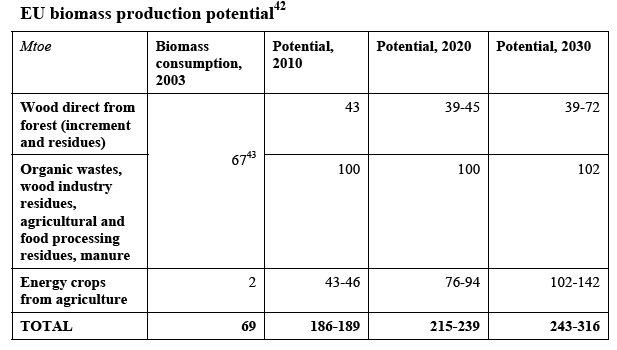
EU biomass production potential

The first column of the table shows the quantities of EU-produced biomass used for energy purposes today. The following columns show the potential contribution in 2010, 2020 and 2030. The potential for 2010 is 2½ times the contribution today. The potential for 2020 is 3 to 3½ times the contribution today, and the potential for 2030 is 3½ to 4½ times that of today.
Forests, wastes and agriculture all make a big contribution to this potential for growth. The increase from forestry comes from an increase both in fellings and in the use of residues. The increase from agriculture is driven by the reform of the common agricultural policy.


Research priorities - transport biofuels

The main area of research is second-generation biofuels made from various biomass resources and wastes, e.g. bioethanol, biodiesel, DME. The technical feasibility of converting cellulose material (straw/wood) and organic wastes into bioethanol and biodiesel has been demonstrated. But costs need to be brought down and technology needs to be further developed and demonstrated for commercial-scale production (over 150 000 tonnes a year). If this can be done, second-generation biofuels should offer three major advantages:
• they will secure a higher market share for biofuels by allowing the use of a wider range of raw material;
• the cultivation process (if any) could be less environmentally intensive than for ordinary agricultural crops;
• this lower intensity will be reflected in lower greenhouse gas emissions from cultivation.