Showing posts with label South America. Show all posts

April 4, 2007

Latin America's Blueprint for Green Energy

The IDB commissioned Garten Rothkopf, a consulting firm which works with corporations on long-term global strategies, to perform an analysis that would serve as a blueprint to its development of energy technologies in the Americas.

What is the IDB? According to their website. "The Inter-American Development Bank was established in 1959 as a development institution with novel mandates and tools. It is the main source of multilateral financing for economic, social and institutional development projects and trade and regional integration programs in Latin America and the Caribbean. It is the oldest and largest regional development bank."

This report begins with the major trends in global energy: the drivers of demand, the constraints on supply, and the twin imperatives of energy security and emissions reductions. The promise of biofuels is then assessed relative to the leading alternative technologies in the transport sector: hydrogen fuel cells and coal liquefaction. This is followed by the “Global Biofuels Outlook 2007”, an assessment of the state of biofuels in 50 countries on 6 continents, highlighting the critical areas of government policy, productive capacity, private sector investment, and research and development.

The report concludes with a blueprint for green energy in the Americas. This strategic blueprint is organized around the four pillars that they project will drive and shape competition and demand: innovation, capacity expansion, infrastructure, and building global markets.

The basic thesis is clear:

Coordination between the government, private sector, universities, and research institutions to strengthen the connection between the scientific research activities and practical technological needs of the sector is critical.


----------------
A Blueprint for Green Energy in the Americas
Strategic Analysis of Opportunities for Brazil and the Hemisphere
Featuring: The Global Biofuels Outlook 2007
Prepared for the Inter-American Development Bank

We are in the midst of a sustainable energy and climate change revolution, directly linked to the other major transformational trends of our time-the rise of the world's emerging economies, the world's rapid urbanization and the revolution in biotechnology. While not a panacea, biofuels represent one important choice in an increasing array of energy options. They have a significant role to play in the reduction of greenhouse gas emissions from transport, developing rural economies, and attracting private sector investment.

This study, prepared by Garten Rothkopf for the Inter American Development Bank, seeks to cut through the hype surrounding biofuels, and alternative energy writ large, and present an objective, fact-based analysis of the region's global competitive position looking forward to 2020. It includes the most extensive study done to date on the global biofuels market, including 50 countries. The report also focuses on the challenges that lie ahead, from ensuring that the choices made are sustainable in terms of their environmental and social impact to recognizing that unprecedented investment and innovation will produce new competitive forces that will require all who would lead to adapt or fall behind.

The growth of biofuels will favor countries with long growing seasons, tropical climates, high precipitation levels, low labor costs, low land costs, as well as the planning, human resources, and technological know how to take advantage of them. Latin America and Caribbean, led by Brazil, already produces 40% of the world's biofuels and is uniquely positioned to take advantage of this growing industry.

"A Blueprint for Green Energy in the Americas" offers a strategic blueprint for IDB activities in the region, to serve as the basis for even more focused and policy-oriented studies in the future.

technorati , , , , , , , , , decentralization

February 16, 2007

Online game is a Climate Challenge

The BBC Weather Centre has a wealth of information on their Climate Change website about global warming - evidence, impacts, adaptation, policies, and links. They recently ran a Climate Change experiment that utilized the spare computing power of a quarter of a million participants - mostly throughout Europe and the eastern U.S. Through this huge distributed processing project, thousands of climate change models could be run and the results computed. Their findings:

• The UK should expect a 4°C rise in temperature by 2080 according to the most likely results of the experiment.
• Heatwaves are on the rise and, by 2080, summer temperatures of 40°C will be common. Winters will also be warmer.
• Summer rainfall is set to decrease and the UK can expect more frequent droughts
• Winters will bring less snow and more rain, especially in the north and west. Storms will be more frequent and more severe.
• Different regions around the world can expect varying levels of warming. New Zealand faces a smaller temperature rise than the UK's 4°C change, while Alaska should prepare for a greater increase

They recently published a free, online serious game that simulates the decision-making process engaged by world leaders in counter-acting the global warming phenomenon. It is important that each stakeholder of the energy/environment dialog recognize the need for coordination of many nations efforts to forestall the effects threatened by interlinked future challenges.

Thanks to our European friends at Biopact for supplying the base information on this story. Monitoring bioenergy stories from their well-researched viewpoint should be a part of the regimen for anyone that is serious about global approaches to solving the energy/environmental challenges before us. A monthly digest of their most relevant stories are published here - see February's digest.


----------------
Why make a game about climate change?

The BBC decided a game might be a good introductory route into climate change and some of the issues this creates for governments around the world. At times it was necessary to strike a compromise between strict scientific accuracy and playability. For this reason, Climate Challenge should not be taken as a serious climate change prediction. Wherever possible, real research has been incorporated into the game.

Apart from the primary goal of creating a fun game, Climate Challenge's producers aimed to:
• give an understanding of some of the causes of climate change, particularly those related to carbon dioxide emissions.
• give players an awareness of some of the policy options available to governments.
• give a sense of the challenges facing international climate change negotiators.

Players must respond to catastrophic events caused by climate change as well as natural and manmade events, which may or may not be linked to climate change. This aspect of the game is meant to give some idea of what could happen as the Earth's climate changes and also introduce the unpredictable nature of some natural events.


technorati , , , , , decentralization,

October 16, 2006

Impact of Global Growth on Carbon Emissions

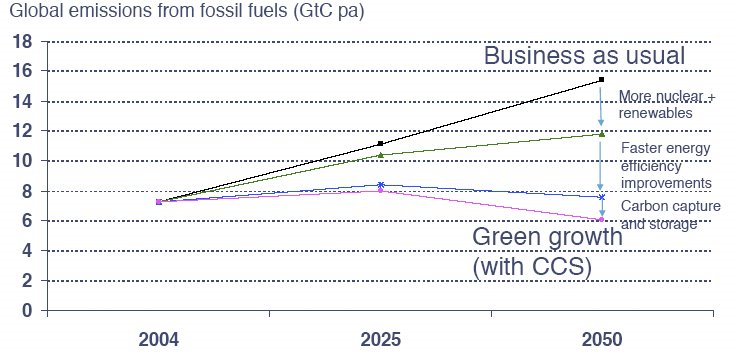
"Business as usual" could could have serious long-term consequences for global energy consumption and carbon emissions. According to a report released by PriceWaterhouse-Coopers (PwC) last month, global carbon emissions from fossil fuels are going to more than double by the year 2050 unless a number of significant policy changes are enacted soon to deploy technological emission reduction measures.

In March 2006, PwC published a report, The World in 2050: How big will the emerging market economies get and how can the OECD compete?, on the rapid growth of the "E7" emerging economies (China, India, Brazil, Russia, Mexico, India, and Turkey). They project the combined economies of these countries could be 25-75% greater than the G7 countries (U.S., Japan, Germany, UK, France, Italy, Canada) by 2050.

The questions unaddressed by that report - what consequences on global climate will that growth cause? What is the need for change?

These questions are covered in a follow-up study, The World in 2050: implications of global growth for carbon emissions and climate change policy released in September. In it, the author provided a baseline estimate of carbon emissions with the current rate of energy efficiency. He then developed five different scenarios incorporating more successively aggressive measures.

It is a sober look at the paths open to us and the need to start implementation. Our leaders must recognize the need to start deploying clean solutions now and adjust them as we go. Civilization cannot afford to squander decades (as we have since the last big oil crisis) holding out for "ideal" solutions. According to PcW:

The analysis also suggests that there could be significant costs to delay, given the time required to develop and implement the necessary technologies and policies. As emissions from the faster-growing emerging economies will almost certainly continue to rise over the next few decades, the G7 economies may need to take the lead in reducing their carbon emissions.

But this should create major new market opportunities, allowing companies in the established OECD economies to specialise in areas of comparative advantage, while their consumers benefit from low cost imports from the emerging economies — a "win-win" outcome rather than "one winner takes all".

A few excerpts:

-------------------------
The World in 2050: implications of global growth for carbon emissions and climate change policy
Report outlines 'Green Growth Plus' strategy that could curb global carbon emissions without significantly reducing long-term economic growth
John Hawksworth, Head of Macroeconomics, PriceWaterhouse-Coopers

The report considers six possible scenarios but focuses most attention on two key possibilities:

• A baseline scenario in which energy efficiency improves in line with trends of the past 25 years, with no change in fuel mix by country; this ‘business as usual’ scenario acts as a benchmark against which to assess the need for change, rather than as a forecast of the most likely outcome; and
• A scenario called Green Growth + CCS, which incorporates possible emission reductions due to a greener fuel mix, annual energy efficiency gains over and above the historic trend, and widespread use of carbon capture and storage (CCS) technologies. Of the scenarios considered in the report, only this ‘Green Growth Plus’ strategy stabilises atmospheric CO2 concentrations by 2050 at what the current scientific consensus suggests would be broadly acceptable levels.

The chart below shows how it might be possible to get from the baseline scenario to the preferred Green Growth + CCS scenario for global carbon emissions in three steps.

1. A shift to a much less carbon intensive fuel mix through increased nuclear and/or renewables supply (more than doubling the current non-fossil-fuel primary energy share to around 30% by 2050) and reduced fossil fuel.
2. Energy intensity reductions significantly faster than historic trends (2.6% per annum rather than 1.6% per annum, which would reduce carbon emissions in 2050 by around a third relative to our baseline scenario).
3. Significant investment in carbon capture and storage (CCS) technology and capacity of the order of 1.5GtC per annum by 2050, which could reduce carbon emissions by a further 20%, relative to our Green Growth scenario without CCS.

John Hawksworth concludes: "Our analysis suggests that there are technologically feasible and relatively low-cost options for controlling carbon emissions to the atmosphere. Estimates suggest that the level of GDP might be reduced by no more than around 2-3% in 2050 if this strategy was followed, equivalent to sacrificing only around a year of economic growth for the sake of reducing carbon emissions in 2050 by around 60% compared to our baseline scenario".

"But if this is to be achieved, it will take further concerted action by governments, businesses and individuals over a broad range of measures to boost energy efficiency, adopt a greener fuel mix, and introduce carbon capture and storage technologies in power plants and other major industrial facilities".


technorati , , , , , , ,

August 10, 2006

Ethanol Costs will Go Down


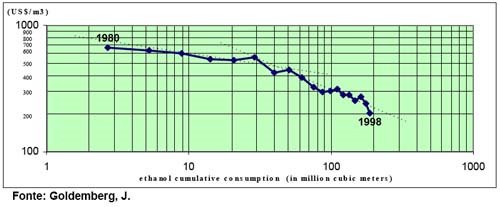
The chart, titled "Learning Curve - The Example of Brazilian Ethanol as a Base for Biofuels", prepared by BNDES, Brazil's federal development bank, shows how ethanol production costs decreased significantly between 1980 and 1998.

Another "inconvenient truth" for those who would deny the economic feasibility of ethanol is that, as our learning curve goes up, the cost of production will come down. That is the documented experience of Brazil as reported by our friend Henrique Oliveira of Ethablog in his article titled LEARNING CURVE: ETHANOL PRODUCTION COSTS DECREASE 75% IN 25 YEARS.

As the chart above shows, between 1980-1998 the price of production went down from nearly $700 to $200 per cubic meter. It is estimated to be 25% of the starting cost today with the trend continuing to go down. Part of the reason is that the rapidly rising consumption created an economy of scale. There were also improvements in technology, logistics, and infrastructure as the industry matured.

This happened without any expansion of the types of feedstock being used. It is expected that the development of cellulosic feedstock conversion technology will enable more plant matter (i.e., corn stover and agricultural waste) to be converted. It will also enable cheaper, uncultivated crops, forestry waste, and urban waste biomass to be used which will further depress the price of production.


technorati , , , , ,

July 16, 2006

Could an Ethanol Boom Hurt the World's Poor?

Ethanol feedstock is usually human feedstock - meaning that most of the raw material for fermenting ethanol comes from food crops - corn, sugar cane, and grains. Because of this, the concern often arises that replacing fossil fuels with renewable fuels based on food crops would deprive the world's starving poor in favor of the super-consuming privileged classes.

There are many assumptions in the argument - that ethanol will always be made from food crops, that feedstock dedicated to fuel production would otherwise be used for food, that industry in poor regions of the world wouldn't benefit the economic and physical health in those regions.

The best debate I have seen on the subject has been posted by Laurens Rademaker of Biopact. In his article he responds to a presentation by the president of Washington D.C.-based environmental research group, Earth Policy Institute,

"This is shaping up as competition between the 800 million people in the world that own automobiles and the 2 billion low- income people in the world, many of whom are already spending over half their income on food." Lester Brown of the Earth Policy Institute


Laurens obviously disagrees and his point-by-point arguments make a persuasive case. Below is an excerpt but I recommend reading the full text of his position.

-----------------

“Ethanol boom could hurt world’s poor” - BioPact strongly disagrees

Together with the UN's FAO, which thoroughly analysed the stakes long ago and which concludes that bioenergy and biofuels can cut poverty, provide energy to the poor, reduces oil import costs for developing country governments, and opens a unique economic opportunity to connect millions of poor energy farmers to a global market where they can sell their biofuels at great competitive advantage -- we obviously disagree with the Earth Policy Institute.


technorati , , , , , , ,

July 10, 2006

BRAZIL: Impact of the Ethanol Gold Rush

Biopact Blog has featured a review of a new blog that offers an English language insider's look at Brazil's burgeoning ethanol industry. The author of the blog is Herique Oliveira, a U. of Michigan MBA grad student who grew up in Brazil.

As Laurens Rademakers of Biopact relates, there are numerous interesting articles at Ethablog.

The one that most interested me is one about the impact that world attention to Brazil's ethanol industry has made on that industry and the prices of related commodities and products.

---------------------

ETHANOL GOLD RUSH BEGINS IN BRAZIL

Now it's official: the ethanol gold rush is on in Brazil.

Expect the price of everything in the country related to ethanol to go up substantially in the coming weeks: land, refineries, equipment, and anything else that can be, at least hypothetically, sold to the foreigners who will come streaming into Brazil in search of the fuel the country has been using for over 30 years.

Or so hope many Brazilians, from government officials in Brasilia to farmers in the Brazilian Midwest to businessmen in the city of Sao Paulo. Ever since the June 21st. edition of "Exame" magazine, the Brazilian equivalent of "BusinessWeek", brought a cover story with the headline: "Ethanol - the World Wants It. We Have It", ethanol has been all the rage in the country.

Brazilians have seen ethanol sold at fueling stations ever since the Pro-Alcool program was created by the Federal government in 1975. To a Brazilian, filling up the tank with ethanol is no big deal - many do not see any reason for all the fuss that surrounds the fuel's introduction to markets in the U.S. and the E.U.

But they certainly see the opportunities. They have watched the convergence of factors - 9/11, the Iraq War, political instability in the Middle East, the growing climate crisis - that is associated with escalating oil prices. Now, with the Exame article, they suddenly realize that the rest of the world has no realistic alternative for the coming years but to follow the path they chose to go down 31 years ago.

But the big question I have heard since the article came out is, "Can Brazil really produce enough ethanol for the entire world?" Market insiders know that Brazil has had trouble producing enough ethanol for its own fleet of cars and light trucks, which, at about 15 million, is 23 times smaller than that of the U.S. Can Brazil then serve as energy basket to the world?

-------------------

To read Henrique's opinion on that question, continue to read the article. There are numerous other interesting articles detailing the production and marketing of ethanol in this enigmatic country (at least for most Americans).


technorati , , , , , ,

June 12, 2006

LAMNET: Latin America Thematic Network on Bioenergy

Got a bioenergy project you want to develop for Latin America, China, or Africa? Then you will want to know about LAMNET.

The main focus of the (LAMNET) project will be the identification of technological objectives and the development of policy options to boost promotion of decentralised biomass production and biomass based energy generation.


This organization has published a publicly accessible, online LAMNET D@tabase containing information on emerging nations' energy consumption, energy import/export, energy prices, current bioenergy generation, and energy prices - organized by country. Check the dates since much of the information was accumulated in 2001.

----------------

LAMNET: Latin America Thematic Network on Bioenergy

The project Latin America Thematic Network on Bioenergy (LAMNET) is funded by the European Commission in the framework of the specific research and technological development programme ‘Confirming the International Role of Community Research’.

The main objective of LAMNET is to establish a trans-national forum for the promotion of sustainable use of biomass in Latin America and other emerging countries.

This global network of 48 institutions (Knowledge Centres and SMEs) from 24 countries worldwide is set up to face urgent needs for improved and regionally adapted bioenergy applications.

The network is coordinated by WIP-Renewable Energies, Germany, in partnership with ETA, Energia Trasporti Agricoltura, Italy and the European Biomass Industry Association, EUBIA. The Latin American organisations CENBIO (Centro Nacional de Referência em Biomassa), Brazil and UNAM (Universidad Nacional Autónoma de México), México act as coordination support points on the South- and Central American continent.


technorati , , , , , ,

May 12, 2006

World Bank Uses Brazil as Funding Benchmark

The World Bank is being flooded with requests by developing nations for funding ethanol projects. According to this report from Reuters, Brazil's sugar cane ethanol economics is used as a benchmark for determining which international projects will get World Bank support.

International deployment of alternative fuel biorefineries will become increasingly important for reducing the economic impact of rising oil prices. The International Energy Agency estimates that, at best, ethanol could make up 10 percent of world gasoline by 2025.

Some excerpts from the report:

--------------------

World Bank "flooded" with ethanol fund requests
Reuters, May 12, 2006

"We've been flooded with requests from lots of countries. There's some requests from Latin America, we've had several from Africa and one or two in East Asia," Marcelo Lessa of the International Finance Corp. (IFC) said from a cane-ethanol mill in Brazil's Sao Paulo state.

Since November, sugar cane project funding requests -- largely in the feasibility stage -- have come in from Mali, Guatemala, Honduras, the Philippines, Colombia, Saint Kitts & Nevis, Mozambique, Tanzania, Egypt and Turkey.

"We'll turn several (plans) down because we believe ethanol production has to be competitive with costs in Brazil; otherwise you might be hurting a country economically," Lessa said.

Projects that are more likely to be approved are in countries with a well-established sugar cane infrastructure such as Colombia, Peru, Mozambique, Angola, Thailand and Australia.

"India's a very large producer. They have efficient mills but they have very high costs because of problems on the agriculture side," such as small farms, he said.

Another benchmark is costs, using Brazilian output costs as the standard. That cost is about $227 per cubic meter, but an 11 percent rise in Brazil's real against the dollar from January to April has made some proposals uncompetitive.


technorati , , , , ,

May 11, 2006

MSNBC Dateline: Vinod Khosla on Cellulosic Ethanol

On the same evening as the 60 Minutes broadcast on The Ethanol Solution Dateline NBC was running their own story about ethanol from the point of view of Vinod Khosla - the billionaire venture capitalist who co-founded Sun Microsystems.

Below are some excerpts. For the complete interview and supporting videos, click on the linked title below.

-----------------

A simple solution to pain at the pump?
Greener and cheaper, ethanol could fuel rural America — and won't feed Mideast terrorism
This report aired Dateline Sunday, May 7
Stone Phillips, Anchor

Pain at the pump is the price of this country’s addiction to oil. Americans are feeling it intensely—outraged over oil company profits, fearful that another hurricane in the gulf, or a terror attack in the Middle East is all it would take to send prices even higher.

But what if there was one solution to all of this? Something that could solve America’s energy crisis, strengthen our national security, and help save the planet at the same time?

Vinod Khosla: I looked, did my research and found this was brain dead simple to do.

He’s talking about a new generation of ethanol— the fuel made from plants. It’s one fuel he says is just around the corner and will deliver 4 to 10 times the energy of today’s corn ethanol. Khosla knows, because he’s talked to top scientists, visited labs and he’s a bio-medical engineer himself. He believes this new ethanol can replace gasoline and eliminate America’s dependence on foreign oil.

And that’s exactly Khosla’s vision for America— putting new generation ethanol plants next to paper mills, turning their leftovers into fuel. Or even next to orange juice factories, where he says ethanol from peels could replace petroleum.

But that’s only part of it. To really make America an ethanol nation, Khosla says billions of gallons will come from something as common as prairie grass. He says it’ll be much cheaper and deliver 10 times the energy it takes to make it.

As for the expense, Khosla estimates it would cost about $15 to 20 million to offer ethanol pumps at a thousand gas stations in California.

Khosla: We need to make sure that the major oil companies don’t manipulate the price of oil enough to drive ethanol out of business.

Phillips: Do you believe oil companies would deliberately drop the price of oil?

Khosla: Absolutely. A senior executive of a major oil company came up to me and said, “Be careful.” In a very warning tone he said, “Be careful, we can drop the price of gasoline.”


technorati , , , , , ,

May 7, 2006

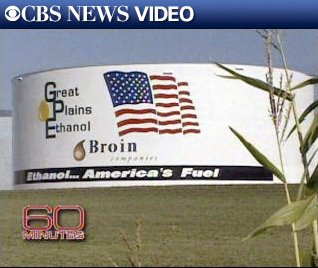
CBS 60 Minutes - The Ethanol Solution - A Review

When you learn that your favorite cause is about to be given a treatment by 60 Minutes you immediately wonder if you should order catering for a wedding - or a wake. After all, "ethanol" has generated a considerable amount of heat over the years. What America needs right now is more light regarding energy issues.

Looks like we'll need extra champagne bottles, the wedding is on. You can access the written transcript of The Ethanol Solution online.

The 60 Minutes broadcast was simple and educational. By highlighting Brazil's success, it provided the best evidence that a significant energy paradigm shift is possible in America. It explained that ethanol is being blended in gasoline and described what E85 is (85% ethanol mixed with 15% gasoline). It showed the personal story of the farming communities who invest their savings to provide employment and have a stake in what many farmers feel is the salvation of their way of life. It showed the ease with which American automobiles can be converted into flex fuel versions that can run on any mixture of gasoline and ethanol. It interviewed General Motors' head Rick Wagoner and reinforced General Motors' Live Green/Go Yellow commitment to aggressively expand the number of the nation's more than 5 million flex-fuel cars.

The only harsh light was cast on the oil industry whose representative, Red Caveney of the American Petroleum Institute, exaggerated the cost of building infrastructure to support E85 ($200,000 per gas station pump). In counterpoint, energy expert Professor Daniel M. Kammen of U.C. Berkeley's Renewable and Appropriate Energy Laboratory (RAEL) contended that switching over to an ethanol infrastructure was far cheaper than Caveney said ($30-$40,000 per pump) and could take a matter of years, not decades.

There were angles that could have been covered.
- If flex-fuel cars don't cost any more than gasoline-only cars, why not legislate that all new cars, including hybrids, be flex-fuel compatible? Brazil did. As the American Petroleum Institute head, Red Cavaney, said "the market is exceptionally limited" because currently only 5 million of the country's 133 million cars can use E85.
- While it did mention the technological prospect of creating ethanol from agricultural waste, switchgrass, and woodchips, it did not give treatment to the emerging technology of converting urban waste to ethanol.
- The story did not mention that the IRS has just published the Alternative Fuel Vehicle Refueling Property Credit, a tax credit of $30,000 for stations installing ethanol pumps. That was announced last week.
- It could have highlighted the environmental benefits of ethanol compared to gasoline.

Overall, it was a very positive story on ethanol and should help legislators and lobbyists to press their legislative initiatives. The tag line, quoted from farmer Larry Meints, said it best:

"It's a win-win thing for the nation, and for our local economy here to create jobs locally, rather than sending the money overseas, and sometimes to people that really don’t like us very well."


technorati , , , ,

April 29, 2006

FAQ: BIOconversion Blog


1. What is "BIOconversion"?

I named this blog "bioconversion" because it is a double entendre. The first meaning is quite literally what is in the dictionary - "a process in which a fuel is generated from waste matter, plant matter, etc., as in using bacteria to feed on waste to produce methane." I think bioconversion is the means by which we will be able to not only sustainably create fuel, but also efficiently rid ourselves of accumulating waste..

The second meaning of "BIOconversion" relies on seeing the word as a contraction of "biomass conversion." Biomass includes matter that is not waste - like corn, sugar cane, switchgrass, and other crops. It also includes waste that we don't typically consider to be biologically based - like tires, auto fluff. It can also be blended with fossil fuels, even coal. New processes can convert ALL of these feedstocks into ethanol or hydrogen, while co-generating electricity. The more biomass we recognize as feedstock, the more fuel we can produce.

The second of three biomass processing blogs, this one covers international biomass conversion issues - process R&D, facility deployments, and new developments. The other two related blogs are the BIOstock Blog and the BIOoutput Blog.

2. Why are so many blog entries about California?

I live in California. I have access to people and events in California that I think would interest people around the globe. California is the launching site of so many technological paradigm shifts that I am convinced that either the impetus to change will occur here first, or the shift will mature here before going global - or both. I have immense appreciation for Brazil and American Midwest where much of the bleeding edge R&D and deployment of infrastructure has already taken place.

3. What do I see as the biggest investment opportunity?

Alot of investors visit alternative energy sites including this one. The iron is hot. There are no sure winners right now and many future winners are at a nascent stage of development. From what I have read and what I know cellulosic ethanol produced by syngas fermentation offers the biggest Energy ROI. The feedstock is the cheapest and most varied, it can be blended before gasification, and requires the least amount time and storage to produce.

4. Do I believe in global warming?

I do believe that most industries and utilities are wasteful on a grand scale - particularly in developing nations where environmental standards have been sacrificed to achieve more energy. We have a responsibility to clean up waste and develop more energy-efficient techniques - which is why I am frustrated by environmental Luddites who obstruct attempts to do just that. Clean technologies that can convert waste into energy and useful products are a WIN-WIN for the environmental cause.

I think conversion technologies (CTs) have been proven to provide positive environmental benefits for remedying industrial waste. Any deficiencies in CTs can be corrected and society should have vigilence and patience, not fear, in dealing with unintended effects.

5. What is the significance of a decentralized energy paradigm?

Right now, energy production is centralized to a dangerous extent. Too many resources being managed through too few stable countries, too few refineries distributed among too few locations, and too many managers and politicians who lack principle and foresight. Fortunately, "dinosaurs" give way to "mammals."

Since biomass is plentiful throughout the world and feedstock streams for bioconversion are so varied, each ecosystem and culture could develop unique facilities based on their own natural resources, waste, climate, local demand, and geographic location. The more decentralized the production of energy, the less geopolitical pressure and fear of deprivation throughout the world.

Ethanol cannot be piped like oil can which makes it more important that the source of production is near the source of use.

In short, "fear" of shortage is the primary cause driving up the price of fossil fuels. It is a fear that can be remedied with leadership, patience, and creativity.

6. What needs to happen next in California?

For California to lead the world in developing bioconversion technologies, the state legislature needs to loosen biorefinery permitting restrictions. The executive branch will conduct emissions testing as facilities are deployed. They will halt operations who can't meet environmental regulations, but they must allow them the opportunity to find solutions to comply. Our energy future is best secured with problem solving - not problem avoidance.

The legislature should also enact diversion credits to municipalities that reduce landfill use by recycling unrecyclable waste through conversion facilities.

Pilot and commercial-scale facilities should begin deployment at the earliest possible time. We won't be able to fine-tune conversion technologies and the necessary supporting infrastructure if there are not commercial-scale facilities to process the various feedstock and blends, and test for emissions.

Once proven, investing companies will have new technology to market and help deploy throughout the world.

7. What is the significance of the Rubik's cube imagery on the Blogs?

The Rubik's cube is emblematic of the multi-faceted energy puzzle that confronts civilization. This four blog series is my attempt to create some semblance of order out of the chaos of global interlinking challenges - geopolitics, employment, pollution, energy, waste, carbon emissions, etc. Each Blog is an attempt to work on a side of the puzzle - BIOstock, BIOconversion, BIOoutput, and BIOwaste. Solve these and I believe many international problems will be substantially mitigated.


technorati

March 24, 2006

Ethanol Industry Braces for Growing Pains

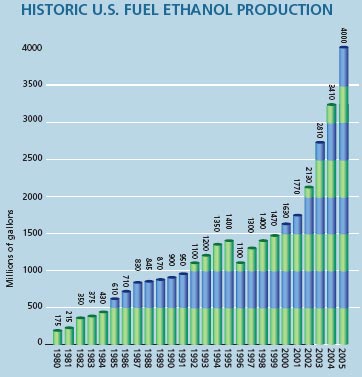
Even with U.S. production of ethanol trending upward at a geometric rate and flex-fuel auto technology starting to receive the attention it deserves, journalists are drafting stories about higher oil pump prices being blamed on the ethanol industry (see below).

We expect jumps to happen for any commodity when a spike in demand outstrips supply. However, this spike is the result of oil companies finally deciding to substitute ethanol as an oxygenate in place of MTBE in advance of state legislatures mandating that they do so. So who's to blame?

I think it is a good sign. To make an omelet, you have to break some eggs. We should expect that a rapid acceptance of ethanol as a renewable fuel will create infrastructure overloads and a period of adjustment for both producers and buyers - and, incidentally, the oil companies. Meanwhile the benefits of bioenergyfar outweigh the liabilities we face longterm from over-dependence on fossil fuels.

--------------------------

Ethanol Industry Braces for Growing Pains
By BRAD FOSS
AP Business Writer

WASHINGTON (AP)-The ethanol industry might not be ready to satisfy the expected summertime jump in demand. And by crimping the overall supply of motor fuel, this could contribute to a spike in gasoline pump prices at the start of the country's peak driving season.

That, at least, is the view of the Energy Department, which issued a report last month detailing the challenges midwestern ethanol producers will have in getting their fuel to key markets along the East Coast because of railroad, trucking and other distribution bottlenecks. The report also highlighted concerns about the limited output capacity of an industry still in its infancy.

The Renewable Fuels Association, a trade group representing ethanol producers such as Archer Daniels Midland Co. and Pacific Ethanol Inc., says the industry's challenges and their influence on gasoline prices are being overblown. The association sent an angry letter to the Energy Department last week, questioning the overall thoroughness of its research and accusing it of creating "unnecessary fears in the marketplace."

Now it is up to ethanol producers to bridge the gap. While U.S. ethanol producers have the capacity to produce roughly 4.3 billion gallons - or 280,000 barrels per day - in 2006, the near-term crunch means more imports will be needed from Brazil, Dinneen said. The United States imported more than 150 million gallons of ethanol in 2005.

Dinneen said part of the problem for the U.S. ethanol industry right now is that it was caught off guard by the oil industry's faster-than-expected phaseout of MTBE. "Refiners made the decision to accelerate the removal of MTBE, not ethanol producers," Dinneen said.

Perhaps the biggest issue is distribution.

Gasoline with or without MTBE can be shipped in large quantities through an extensive network of pipelines. But ethanol, which tends to corrode pipelines, must be transported on trucks, trains and barges in relatively small batches to storage terminals where it is then blended with gasoline.


technorati

February 23, 2006

RFA: Ethanol Industry Outlook 2006

Released 2/16/06, the the Renewable Fuels Association (RFA) Ethanol Industry Outlook is a must read for anyone interested in the Ethanol industry. According to this document this is a milestone year because of recent legislation and the future is bright.

From Niche to Nation
Ethanol Industry Outlook 2006

February, 2006

"From Niche to Nation” seems an appropriate theme for this year's Ethanol Industry Outlook. It reflects the unprecedented growth that has occurred over the past several years. Once serving just niche markets in the Midwest, ethanol is now a ubiquitous component of the U.S. transportation fuels market, as ethanol is now sold from coast to coast, and is blended in 30% of the nation's gasoline.

We feature new technologies designed to enhance production, reduce energy inputs and lower costs. These technologies are changing the face of the U.S. ethanol industry, and we look forward to continued innovation that improves efficiencies. Perhaps most importantly, we take an in-depth look at passage of the Energy Policy Act of 2005 and the Renewable Fuels Standard (RFS), in which the U.S. has made an historic commitment to renewable biofuels as part of our nation's energy supply.

Impact of the RFS by 2012

• Reduce crude oil imports by 2 billion barrels and reduce the outflow of dollars largely to foreign oil producers by $64 billion;
• Create 234,840 new jobs in all sectors of the U.S. economy;
• Increase U.S. household income by $43 billion;
• Add $200 billion to GDP between 2005-2012;
• Create $6 billion in new investment in renewable fuel production facilities; and
• Result in the spending of $70 billion on goods and services required to produce 8 billion gallons of ethanol and biodiesel by 2012. Purchases of corn, grain sorghum, soybeans, corn stover and wheat straw alone will total $43 billion.
Source: LECG, LLC, May, 2005

Biomass Gasification

A biomass gasifier uses biomass to provide an energy source for both steam and power generation, increasing the overall efficiency of energy generation while reducing emissions. Central MN Ethanol Co-op will have an operational biomass gasifier in 2006, fueled by wood waste that will eliminate the refinery's use of natural gas. The unit will operate on a local supply of sawdust, slash, storm damage, yard waste and wood manufacturing residue. When fully operational, the refinery is expected to burn 280 tons of wood waste per day.

Chippewa Valley Ethanol Co. also plans to install a biomass gasifier designed to operate on a range of feedstocks including corn stover, distillers dried grains, corn, wheat straw and wood wastes.

Securing America's Energy Future

Ongoing violence in the Middle East, disruption of oil production in the Gulf of Mexico due to an active hurricane
season, and the growing demand for oil from countries like China and India contributed to oil prices soaring over $60 a barrel in 2005.
• 65% of the U.S. crude oil supply was imported in 2005.
• 71% of the U.S. crude oil supply is estimated to be imported by 2025.

Cleaner Fuel, Cleaner Environment

Ethanol use has been the reason that cities such as Denver, Colorado, have seen dramatic reductions in air pollution over the past two decades. The use of ethanol, consisting of 35% oxygen, is a key ingredient in reducing dangerous tailpipe emissions. Because of its high oxygen content, ethanol-blended fuel produces a cleaner, more complete combustion that reduces emissions.

According to analysis by Smog Reyes, the use of 10% ethanol blends reduces tailpipe fine particulate matter (PM)
emissions by 50%, carbon monoxide emissions up to 30%, toxics content up to 13% (mass), and toxics content up to 21% (potency). Ethanol blends also reduce secondary PM formation by diluting aromatic content in gasoline.

“Ethanol-blended fuels reduced CO2-equivalent greenhouse gas (GHG) emissions by approximately 7.8 million tons in 2005, equal to removing the annual GHG emissions of 1.18 million cars from the road. ”
~ Argonne National Laboratory, GREET 1.7 Model

As concerns over greenhouse gas emissions grow and supplies of world oil are depleted, Europe and countries like China,
India, Australia and some Southeast Asian nations are rapidly expanding their biofuels production and use.

Ethanol Programs Worldwide

Brazil - Requires 25% ethanol blends; provides preferential tax treatment
Argentina - Requires use of 5% ethanol blends over the next five years
Thailand - All gasoline sold in Bangkok must be 10% ethanol
India - Requires 5% ethanol in all gasoline
Australia - Voluntary blending of up to 10% ethanol
Great Britain - Provides incentives for ethanol production at 36 cents per liter
European Union - 2% (energy content) biofuels target by 2005, increasing to 5.75% by 2010
Canada - Tax benefits for ethanol since 1992 (provincial mandates)

More than 5 million cars in the U.S. are designed to run on E85. 650 retail gas stations across the country are pumping E85 today, more than a 300% increase from 2004.
Source: National Ethanol Vehicle Coalition, January 2006

A recent study found that the U.S. could produce the equivalent of 7.9 million barrels of oil per day by 2050, more than 50% of our current total oil use for transportation. Biofuels could:
• Virtually eliminate our demand for gasoline by 2050
• Be cheaper than gasoline and diesel, saving about $20 billion per year on fuel costs by 2050
• Increase farmers profits by more than $5 billion per year by 2025
• Reduce greenhouse gas emissions by 1.7 billion tons per year, equal to more than 80% of our transportation-related emissions in 2002
Source: 'Bringing Biofuels to the Pump: An Aggressive Plan for Ending America's Oil Dependence,” Natural Resources Defense Council, July 2005

February 18, 2006

Replacing Petroleum with Biofuels and Renewable Energy

Perhaps no other more highly respected publication speaks on behalf of a concern for preservation of the earth and mankind than National Geographic. Reducing the "addiction to oil" means more than just reducing our import of Mideast petroleum. It means broadscale replacement of oil with biofuels and other renewable energy. Below are some excerpts from an article they published in response to President Bush's State of the Union commitment to reduce oil imports.

---------------------

"Addicted to Oil": How Can U.S. Fulfill Bush Pledge?
Richard A. Lovett
for National Geographic News
February 14, 2006

The U.S. imports approximately 60 percent of its oil, but relatively little comes from the Middle East.

Only one Persian Gulf country is among the top five foreign sources: Saudi Arabia, which ranks third, behind Canada and Mexico. (The other members of the top five are Venezuela in South America and Nigeria in Africa.)

Reducing Middle Eastern imports therefore won't cure our reliance on foreign oil, says Ray Kopp, an economist at Resources for the Future, a nonpartisan think tank.

Even if we imported no Middle Eastern oil, we'd be vulnerable to political instabilities in the region, Kopp says, because global oil prices are tightly linked.

The U.S. is also committed to allies that are strongly dependent on Middle Eastern oil, says Alex Farrell, a professor in the Energy and Resources Group (ERG) at the University of California, Berkeley.

Another approach is by switching to ethanol and other plant-based biofuels.

In the U.S. ethanol is made by fermenting corn in industrial plants. (Brazil makes ethanol from sugar cane.) (See "Ethanol More Energy Efficient Than Thought, Study Says.")

Ethanol is already a billion-dollar industry in the U.S., says Surya Prakash, a chemistry professor at the University of Southern California in Los Angeles.

The U.S. ethanol industry produces about 4 billion gallons (15 billion liters) a year. But in terms of energy output, those 4 billion gallons equal only 2.5 billion gallons (9.5 billion liters) of gasoline, Prakash says.

That's because ethanol generates less power per gallon than gas.

"It's a drop in the bucket," Prakash says. "It can hardly cover three or four days' … usage" of gasoline in the U.S.

Other biofuels may hold greater promise.

These include products made from the switchgrass and wood chips mentioned in President Bush's address.

Prakash estimates that the different forms of biofuel can together probably replace 10 to 15 percent of total U.S. gasoline usage—enough to meet the president's goal of reducing oil imports from the Mideast by 75 percent.

Daniel Kammen, also in the ERG at U.C., Berkeley, is more optimistic.

Currently, he says, enough waste biomass is being generated by lumbering, by farming, and as urban waste to meet 10 percent of U.S. transportation needs.

With a major commitment, Kammen thinks it might be possible to replace all of the nation's oil with biofuels.

February 11, 2006

GLOBAL: Brazil - A Model for Global Biofuel Industry

It doesn't take much "vision" to project what a flex-fuel society (one that exploits the use of a variety of fuels) looks like. While America's response to the energy crisis of the 70's was to buy smaller, more gas efficient (predominantly Japanese) vehicles, Brazil decided to develop a native alternative fuel economy that would not be so reliant on foreign sources of fuel.

Our response only led to more energy dependence and has been compounded by a worsening balance of trade, pollution, and political intrigue. Meanwhile, Brazil is well positioned to lead the world toward a more decentralized energy landscape based on fuels made from crops and biomass.

Below is an article that appeared on The Truth about Trade and Technology website.

---------------------

Brazil leading U.S. in renewable fuels race
by: Dale Johnson

As President George W. Bush was advocating the nation seek greater energy independence using renewable resources, a small delegation of Midwesterners returned from Brazil where Bush’s dream is already a reality.

Three decades ago, Brazil was importing 90 percent of its petroleum consumption, and was hit hard by the 1973 oil embargo. Brazil launched a policy of energy independence, with ethanol from sugarcane the foundation.

Today, Brazil’s ethanol industry is flourishing. Brazil is the world’s largest ethanol producer at 4.4 billion gallons annually. The United States’ ethanol output, while spurting the last two years, totaled 4 billion gallons in 2005.

“They are way ahead of us in biofuels policy,” states Joel Severinghaus, an international trade analyst with the Iowa Farm Bureau. He recently led a 13-member Midwestern delegation on a 10-day biofuels study tour of Brazil.

The stark realization of what can be achieved if a nation sets a policy is painted across southern Brazil’s sugar-ethanol landscape. Ethanol from sugarcane costs less than $1 a gallon to produce ($1.50 for anhydrous ethanol with the last 3 percent of water removed). Ethanol from corn in the United States costs about $1.50 a gallon.

Brazil’s National Alcohol Program gives tax incentives for ethanol production and ethanol-powered automobiles. Brazil’s renewable fuel policies have reversed the exodus of energy dollars.

“In the 1970s and 1980s, Brazil pushed 100 percent ethanol as a fuel source,” explains Severinghaus. Automakers adapted and produced vehicles to burn pure ethanol. The goal changed buying patterns and pushed E100 to 55 percent of all gasoline consumed. The majority of new cars now sold have flex-fuel engines that can run on E100.

Today, Brazilian motorists can choose between E25, E100, and diesel fuel (in trucks only since no cars are allowed to have diesel engines).

Sugarcane is the base feedstock of Brazil’s ethanol industry.

Ethanol plants are co-located with sugarcane mills, primarily in Sao Paulo state, home to two-thirds of the plants.

“The Brazilian ethanol plants are completely energy self-sufficient,” exclaims Severinghaus, “plus, at the flip of a switch, they can produce either ethanol or crystalline sugar on any given day, whichever is more profitable.

February 1, 2006

The Military Surcharge for Oil

It has been said that the War on Terrorism is the first war that the U.S. is paying for both sides of the conflict. Our "oil addiction" is compromising our national security.

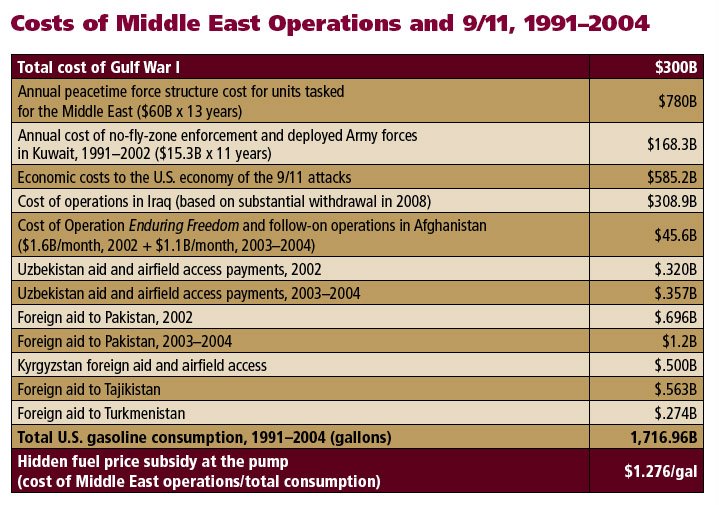
America pays a "national security surcharge" for each gallon of oil that is imported from the Middle East. The cost in blood can never be overestimated. But what has been the per gallon cost paid by the U.S. Treasury for military defense of our interests in the Middle East since 1991 and the first war in Iraq? This would be an externalized military cost that we do not see at the pump. It is also a cost that we do not incur for alternative fuels like E85 or biodiesel.

In an award-winning essay posted on the National Defense University website Lt. Col. John Amidon talleyed the the 1991-2004 military costs of this unreported subsidy and then divided that total by the number of gallons consumed in the U.S. He arrived at a price of $1.276/gallon. Since about 10% of our oil is imported from the Middle East, the actual per gallon surcharge for imported oil is about ten times higher ($12.50/gallon)!

Like Thomas L. Friedman, Lt. Col. Amidon calls for a "Manhattan Project" response to the Middle East petroleum dilemma because of the direct military costs of our dependence. He provides a reasoned two-phased approach to replacing oil import dependence which includes the production of cellulosic ethanol using domestic biomass and urban waste feedstock.

His article includes discussions about the history of Middle East oil dependence, Hubbert's peak oil forecasts, the political instabiity of the Middle East, the military challenge and costs, U.S. consumption patterns, and his two-phased "Manhattan Project" approach to resolving the dilemma. Excerpts from the article...

------------------------------------


America's Strategic Imperative: A "Manhattan Project" for Energy
by Lt. Col. John Amidon, USAF
(Chairman of the Joint Chiefs of Staff award-winning essay appearing in the Joint Forces Quarterly of National Defense University)

Taken in whole, the National Energy Policy does not offer a compelling solution to the growing danger of foreign oil dependence. The 2004 Department of Energy budget for all types of renewable energy totaled $1.3 billion, increasing just 0.1 percent from 2002 to 2004, while lagging the entire Department of Energy budget, which increased 5.9 percent. Even if ANWR were fully exploited, proven reserves total about 7.7 billion barrels of recoverable oil, enough to supply the Nation for just over a year. Although the National Energy Policy sets forth a range of conservation and alternative technologies, no meaningful fiscal policy steps have been taken to bring them to the fore.

Corn is a poor choice for ethanol feedstock since it is the most irrigation-and fertilizer-intensive crop grown in the United States, and corn used for ethanol drives cattle feed prices higher, creating hidden costs at the grocery store. Although a nascent corn ethanol industry has developed, future expansion should be discouraged through a removal of the tax regime. Unsubsidized corn ethanol actually costs $2.24 per gallon to produce, making it uneconomical except in times of very high oil prices.

The biorefinery and cellulosic ethanol. Instead of valuable corn, the biorefinery produces ethanol using the starches and cellulose present in agricultural waste and byproducts such as corn stalks, rice straw, paper mill waste, recycled urban waste, and dedicated woody stemmed crops. Many of these sources of cellulosic ethanol are considered negative-cost feed stocks, meaning they have no food value and farmers must pay for their disposal. This gives cellulosic ethanol a much higher net energy balance than corn-based ethanol. Studies at candidate biorefinery sites in Indiana and Nebraska found that collocating ethanol biorefineries with existing power plants would allow production for $1.05/gallon to $1.60/gallon depending on the biomass selected. Cellulosic ethanol offers great promise for rural areas that have seen considerable depopulation due to modern farming methods.

One cellulose ethanol plant would enhance energy security by replacing crude oil imports of 2.4 to 2.9 million barrels per year; increase farm income by $25 million per year by creating economic value for residues that currently have little to no value or are simply viewed as waste; create economic development by creating over 1,000 new jobs during peak construction, and almost 200 new permanent jobs and about 450 spin-off jobs.

Biorefineries also hold great promise for urban areas. A typical large city has a substantial surplus of yard waste and wood debris, products that can no longer be deposited in landfills. New York and Philadelphia pay $150 per ton to dispose of municipal solid waste. Creating a simple urban wood recycling routine of household recycling bins would ensure a steady biomass supply and strengthen the economics of urban biorefineries through proximity to markets. Building an urban biorefinery in the hundred largest metropolitan areas could produce 7 billion gallons of ethanol a year, offsetting imported oil by 5 percent while helping solve urban waste problems.

The biorefinery is not a fanciful dream. In 1975, Brazil initiated a domestic ethanol program based on sugar cane waste. Over its 30-year life, the ethanol industry has produced $50 billion worth of ethanol while supporting 700,000 Brazilian jobs. Electricity cogenerated at biorefineries provides 9 percent of national requirements. Ethanol supports a fourth of domestic petroleum demand and can be priced more cheaply than gasoline. According to testimony in the Senate, sufficient cellulosic biomass is available in the United States right now to displace up to 10 percent of today’s oil imports.

The 2005 Department of Energy budget earmarks $2.5 billion for all categories of energy research. Given that the United States has spent $2.2 trillion over the past 14 years seeking energy security through military action, $50 billion spent to accelerate the arrival of PHEVs, TCP biorefineries, or other as-yet-undefined technology would seem a policy decision ranking with Thomas Jefferson’s Louisiana Purchase.

An ancillary bonus—clean air. Environmentalists have championed many of the above ideas for years but have been largely ignored or grudgingly placated with half-measures. Until now, economic considerations have trumped many of the environmentalists’ arguments as cheap gas and lack of government commitment knocked the props out from under the green platform. The Manhattan Project for energy would provide an ideal convergence of interests, bringing the economist, diplomat, soldier, and environmentalist under the same tent. In addition to girding energy security, PHEVs and TCP biorefineries offer dramatic improvements in the pollution impact of the transportation sector by either eliminating noxious byproducts entirely or transferring to less polluting energy sources.

January 25, 2006

FORTUNE says: Ethanol is the answer to the energy dilemma

Ethanol, and specifically cellulosic ethanol, is making the BIG MONEY time with an article in Fortune magazine. This lengthy, and yet breathless, article places the focus squarely on the benefits of an ethanol renewable future with background information about Brazil's bold and successful energy policy and the impact flex-fuel automobiles has made to secure low prices in the face of shortages of either petroleum or ethanol.

Below are some choice excerpts from the article.

-----------------------

How to Beat the High Cost of Gasoline. Forever!
Stop dreaming about hydrogen. Ethanol is the answer to the energy dilemma. It's clean and green and runs in today's cars. And in a generation, it could replace gas.

More than five million Tauruses, Explorers, Stratuses, Suburbans, and other vehicles are already equipped with engines that can run on an energy source that costs less than gasoline, produces almost none of the emissions that cause global warming, and comes from the Midwest, not the Middle East. These lucky drivers need never pay for gasoline again--if only they could find this elusive fuel, called ethanol.

Instead of coming exclusively from corn or sugar cane as it has up to now, thanks to biotech breakthroughs, the fuel (ethanol) can be made out of everything from prairie switchgrass and wood chips to corn husks and other agricultural waste. This biomass-derived fuel is known as cellulosic ethanol. Whatever the source, burning ethanol instead of gasoline reduces carbon emissions by more than 80% while eliminating entirely the release of acid-rain-causing sulfur dioxide. Even the cautious Department of Energy predicts that ethanol could put a 30% dent in America's gasoline consumption by 2030.

Energy visionaries like to dream about hydrogen as the ultimate replacement for fossil fuels, but switching to it would mean a trillion-dollar upheaval--for new production and distribution systems, new fuel stations, and new cars. Not so with ethanol--today's gas stations can handle the most common mixture of 85% ethanol and 15% gasoline, called E85, with minimal retrofitting. It takes about 30% more ethanol than gasoline to drive a mile, and the stuff is more corrosive, but building a car that's E85-ready adds only about $200 to the cost. Ethanol has already transformed one major economy: In Brazil nearly three-quarters of new cars can burn either ethanol or gasoline, whichever happens to be cheaper at the pump, and the nation has weaned itself off imported oil.

And have you heard about GM's yellow gas caps? In the next few weeks the auto giant is set to unveil an unlikely marketing campaign drawing attention to E85 and its E85-ready cars and trucks like the Chevy Avalanche. They will sport special yellow gas caps, and if you already own such a vehicle, GM will send you a gas cap free. California governor and Hummer owner Arnold Schwarzenegger is backing a ballot initiative that would encourage service stations to offer ethanol at the pump.

January 4, 2006

General Motors - Marketing Flex-Fuel Cars Nationwide


There are two articles that indicate that General Motors (GM) is getting serious about marketing Flex-Fuel Vehicles (FFV) in the U.S.

FFVs are cars that have been modified to run on both gasoline or ethanol. They feature stronger fuel lines (ethanol is more corrosive than gasoline) and a device that can differentiate the particular blend of ethanol/gasoline in the tank to adjust carburetion. The upgrade cost to GM to produce a FFV from a normal model is surprisingly cheap (a few hundred dollars), particularly when compared to the upgrade cost of hybrids or EVs. They have been manufacturing and marketing FFVs in Brazil for years (where all new cars will be FFVs beginning in 2007).

The first article from Treehugger Blog details a joint initiative made by GM, the State of California, Chevron, and an alternative fuel company called Pacific Ethanol (which Bill Gates has invested in through his personal investment company).

The second article comes from a press release (1/4/2006) by the National Ethanol Vehicle Coalition concerning GM's "First E85 National Ad Campaign". It is reprinted here in its entirety.

-----------------

GM Serious About Ethanol And Flex-Fuel Vehicles?
January 5, 2006 06:07 PM - Michael G. Richard, near Ottawa

Excerpts from the GM press release...

General Motors will help lead a joint demonstration project along with the state of California, Chevron Technology Ventures, and Pacific Ethanol to learn more about consumer awareness and acceptance of E85 as a motor vehicle fuel by demonstrating its use in GM’s flexible-fuel vehicles. The announcement was made as a result of a non-binding understanding made public today at the Los Angeles Auto Show.

GM intends to offer between 50 to 100 of its E85-capable Chevrolet Impala passenger cars and Silverado pickup trucks for consideration in the state’s annual competitive bid process. Flexible-fuel vehicles will be used by the California Department of Transportation (CalTrans) at various operations in Northern California and the state’s Central Valley. Chevron Technology Ventures intends to work with CalTrans to provide E85 fuel and install the necessary refueling pumps in these locations. Pacific Ethanol, a California-based ethanol production and marketing company, intends to provide the ethanol to Chevron Technology Ventures for the project.


GM’s environmental consultant has assured us that GM is aware of the problems facing corn ethanol production and that, while the fuel may initially be made from corn, that cellulosic ethanol is a potential choice for the future. Apparently, GM does have a relationship with Iogen, a leading Canadian cellulosic technology manufacturer (see this press release). We'll have to wait and see where that goes, but the quicker the public stops to think that ethanol equals corn, the better.

-----------------

First E85 National Ad Campaign

Jefferson City, MO – The first flexible fuel vehicle/E85 national advertising campaign has been kicked off by General Motors. Advertisements in the January 4, 2006 editions of the USA Today and Wall Street Journal describes the new GM 2007 E85 Chevy Tahoe.

The full page ads includes statements regarding the ability of the Tahoe to operate on the clean, renewable product. It also directs individuals to the NEVC website, www.E85Fuel.com, to locate availability of E85.

“To my knowledge, this is the first time that any automaker has included a reference to the FFV capability of a vehicle in a national advertisement,” stated Phil Lampert, Executive Director of the NEVC. “While I obviously only have access to regional versions of these two very large circulation papers, we are very pleased that GM has included information in these ads acknowledging the E85 capability of the new Tahoe!”

The 2007 Tahoe will be available January 10. Different from the 2006 Tahoe, the new model will offer a feature called Active Fuel Management™ where the engine will provide power to all eight cylinders when needed and only four when not needed.

General Motors has been a long time supporter of E85 and a member of the NEVC.

December 21, 2005

Brazil and Japan Link Up on Ethanol

Thanks to Green Car Congress, here are two background stories from earlier in 2005 that report on the growing interest in Japan to expand imports of Brazilian ethanol.

-----------------

Brazil and Japan Link Up in Biofuel Pact
4 February 2005

Brazil’s Ministry of Agriculture, Livestock, and Supply and the Japan Bank for International Cooperation (JBIC) are developing a bilateral program to increase the production of ethanol and biodiesel in Brazil and its supply to the Japanese market.

Beginning later this spring, Japanese and Brazilian technicians will create a detailed profile of Brazil’s agro energy sources and develop plans for the expansion of ethanol production in Brazil.

In 2003 the Japanese government regulated a law that authorizes the mixture of up to 3% of alcohol with gasoline.

Now their interest has turned to financing long-term projects capable of increasing Brazilian production and guaranteeing the continuous and regular exportation of this product to Japan.

This will allow Brazil to accumulate exportable surpluses to supply the Japanese market, which, at the outset, already presents a demand of 1.8 billion liters per year.

The future bilateral agreement should also provide incentives to the production of biodiesel in Northeast Brazil.

-----------

Japan and Brazil Cooperating to Promote Ethanol Use
26 May 2005

Bloomberg. Japanese Prime Minister Junichiro Koizumi and Brazilian President Luiz Inacio Lula da Silva agreed on the need for more non-governmental cooperation to promote ethanol use, according to a statement released in Tokyo by the Ministry of Foreign Affairs.

Japan expects to introduce more vehicle fuels containing ethanol, and will pursue ongoing talks with Brazil.

Japan is turning to ethanol as a fuel additive as one measure to help it meet its goal for reducing emissions of greenhouse gases under the Kyoto Protocol. Brazil wants to increase its ethanol exports by boosting sales to Japan, the world’s second-largest gasoline market after the U.S.

Six Japanese prefectures are running tests with ethanol. Currently, gasoline in Japan may contain up to 3% ethanol. Brazil requires gasoline to contain a minimum of 25%.

Separately, Japanese media reported that Mitsui & Co. is working with Brazil’s Petrobras and Vale do Rio Doce (CVRD) to study how to expand Brazil’s exports of ethanol.

Earlier this year, Brazil’s Ministry of Agriculture, Livestock, and Supply and the Japan Bank for International Cooperation (JBIC) announced that they were developing a bilateral program to increase the production of ethanol and biodiesel in Brazil and its supply to the Japanese market.

August 4, 2005

Overdue for a Paradigm Shift

Our dependence on foreign fossil fuel resources is not going to be reduced any appreciable amount in the near future until a clean, renewable liquid fuel alternative is adopted. Ethanol is the obvious choice because: 1) it is already being used as a gasoline volume extender and a high percentage blend alternative, 2) cars that run on both ethanol and gasoline and any blend inbetween are already being manufactured by the major auto companies, 3) ethanol emissions are generally less harmful than gasoline, and 4) new feedstock for the fermentation process include agricultural, forestry, and urban waste - thus reducing environmental plagues while diversifying the range of siting options.

Not many people realize that Henry Ford built the Model T to run on ethanol - but at that time a strong case was made for refining abundant oil into gasoline because it was cheaper than ethanol to produce. So the oil liquid fuel paradigm took root and begat the gasoline refinery and distribution network - and cars were modified to run only on gasoline.

Sixty years later the world experiences a severe "oil crisis". Part of the world (Brazil) responded by adding ethanol back into play as a competitive alternative to oil - reducing dependence on oil and bringing a supportive infrastructure for distillation, distribution, and flex-fuel vehicle manufacture for blends of ethanol and gasoline. Today, Brazil exports ethanol, is not dependent on oil availability, has cleaner auto emissions, and robust demand for its sugar cane crops. A model for a liquid, non-fossil fuel paradigm shift and its positive cultural impact has been amply demonstrated.

Much as been made of the "peak oil" conundrum that bodes catastrophic consequences over the next few decades. Since 1976 there has not been one new gasoline refinery built in the U.S. - so it would seem that we are destined to experience a collapse of the gasoline paradigm. This will be exascerbated by the emerging demand for fossil fuel by China and India. At the same time, there have been over 85 ethanol plants built in the U.S. - based on the standard sugar fermentation process using corn kernels as feedstock. Equally important, distribution networks, ethanol flex-fuel and biodiesel vehicles, and a pro-ethanol enterprise culture has been developed - primarily in the farm states.

The time has come to spread the ethanol paradigm into urban areas using new technology based on gasification of plentiful sources of unrecycled biomass - urban, sewage, MSW, forestry, and agricultural waste. The technology exists and it is far cleaner, safer, and efficient than sugar fermentation. It will also help reduce the need for landfill sites (by about 80%), reduce field spreading of sewage, co-generate green power, and provide a smooth transition away from fossil fuels.

If anyone is interested in one reading about one good example of exciting bioconversion breakthroughs, visit http://www.brienergy.com.