October 9, 2005

A Manhattan Project for Conversion Technology


There is a riveting and extremely important non-fiction book that was published this year by New York Times columnist Thomas L. Friedman called "The World is Flat: A Brief History of the Twenty-First Century."

His thesis is that developing countries (primarily India, China and other Asian countries) are apt to reach parity with the U.S. in the next generation or two because of the "flattening" of opportunity arising from changes in communication and their motivation to succeed in areas we have become complacent, namely science and engineering.

Here's an EXCERPT that relates directly to developing alternative fuels and reducing greenhouse gases (page 283)...

"...it is not easy to get people passionate about the flat world. It takes some imagination. President Kennedy understood that the competition with the Soviet Union was not a space race but a science race, which was really an education race. Yet the way he chose to get Americans excited about sacrificing and buckling down to do what it took to win the Cold War--which required a large-scale push in science and engineering--was by laying out the vision of putting a man on the moon, not a missile into Moscow.

"If President Bush is looking for a similar legacy project, there is one just crying out--a national science initiative that would be our generation's moon shot: a crash program for alternative energy and conservation to make America energy-independent in ten years. If President Bush made energy independence his moon shot, in one fell swoop he would dry up revenue for terrorism, force Iran, Russia, Venezuela, and Saudi Arabia onto the path of reform--which they will never do with $50-a-barrel oil (!)--strengthen the dollar, and improve his own standing in Europe by doing something huge to reduce global warming. He would also create a real magnet to inspire young people to contribute to both the war on terrorism and America's future by again becoming scientists, engineers, and mathematicians.

"I have consistently been struck that my newspaper columns that have gotten far and away the most positive feedback over the years, especially from young people, have been those that urged the president to call the nation to this task. Summoning all our energies and skills to produce a 21st century fuel is George W. Bush's opportunity to be both Nixon to China and JFK to the moon in one move."

ISAF 2005: Alcohol Fuel Flexibility - Progress and Prospects

NOTE: The International Symposium on Alcohol Fuels held its 15th annual meeting Sept. 26-28, 2005 in San Diego, CA. There were many important and timely papers and presentations delivered at the event for which I will provide abstracts.

Thomas MacDonald of the California Energy Commission provided evidence that "alcohol flexible fuels vehicles" (a.k.a., Flex-Fuel Vehicles - FFV - that run on blends of gasoline and ethanol) "represent a mature, low-cost technology option for reducing reliance on petroleum transportation fuels." Should FFV development and infrastructure continue and expand, "alcohol fuel flexibility offers an achievable and inexpensive means of adding motor fuel supply diversity and of substituting alcohol fuels for gasoline."

The most obvious evidence of this is taking place in California. Pollution considerations in metropolitan areas of the state created substantial interest in additives that would oxygenate gasoline to combust more of each gallon while reducing harmful emissions. MTBE's were the initial additive backed and implemented by the petroleum refiners. However, MTBE's could not be stored without leakage, which fouled water resources - the cure being worse than the disease. At the end of 2003, California banned MTBE's in favor of more plentiful and benign ethanol. As a result 5.7% of all gasoline sold in California is actually ethanol as mandated by regulations, approaching one BILLION gallons per year. Currently 99% of this ethanol is imported into California from other states. This E6 (6% ethanol) gasoline runs without modification in all gasoline engines as would for any blend containing up to 10% ethanol (E10).

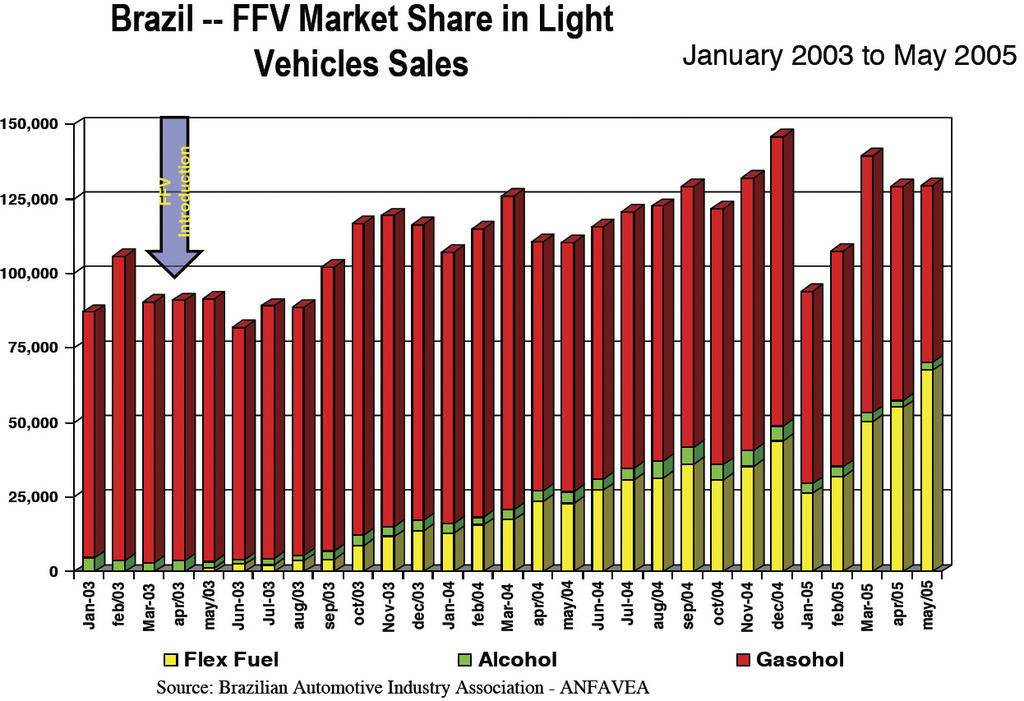
How costly would it be to modify current models of automobiles to make them FFVs? MacDonald states that "the incremental cost to the industry of producing full model lines of FFVs has been reduced to a very nominal amount, $100 per vehicle or less by some industry estimates." Because of FFV demand in Brazil and the Midwestern U.S., most major manufacturers of automobiles (including Ford, GM, Chrysler, and Volkswagen) offer FFV versions of their most popular automobiles.

He offers Brazil as an example of a society that has made a commitment to a fully ethanol/gasoline FFV fleet after 30 years of ethanol and infrastructure development. In Brazil, the average price of gasoline is 1.66 times the average price of ethanol. By 2007, all new automobiles sold in Brazil will be FFVs.


He concludes that "further national initiatives and investments aimed at expansion of FFV production and E85 fueling infrastructure need to be part of a clear overall national agenda for petroleum reduction and a specific straegy for the role of ethanol as a transportation fuel."

October 8, 2005

ISAF 2005: Greenhouse Gas Emission Results of Fuel Ethanol

NOTE: The International Symposium on Alcohol Fuels held its 15th annual meeting Sept. 26-28, 2005 in San Diego, CA. There were many important and timely papers and presentations delivered at the event for which I will provide abstracts.

Michael Wang of the Center for Transportation Research of the University of Chicago provided a paper and presentation on work sponsored by the U.S. Department of Energy. The title of the paper is "Updated Energy and Greenhouse Gas Emission Results of Fuel Ethanol." He stated that their research revealed that corn-based ethanol achieves energy and GHG emission reduction benefits relative to gasoline primarily because of:

1 - Improved productivity of U.S. corn farming in the past 30 years. Ethanol yield has been increased from less than 2.5 gallons per bushel of corn in the 1980s to 2.7 gallons in 2005.

2 - Reduced energy use in ethanol plants over the past 20 years. During that time, per-gallon energy use has been reduced by more than 30% in wet milling plants and by more than 40% in dry milling plants.

3 - appropriate treatment of ethanol's co-products. Another key finding was that cellulosic ethanol, which can be produced from feedstocks such as woody or herbaceous biomass, offers much larger energy and GHG emission reduction benefits than corn-based ethanol.

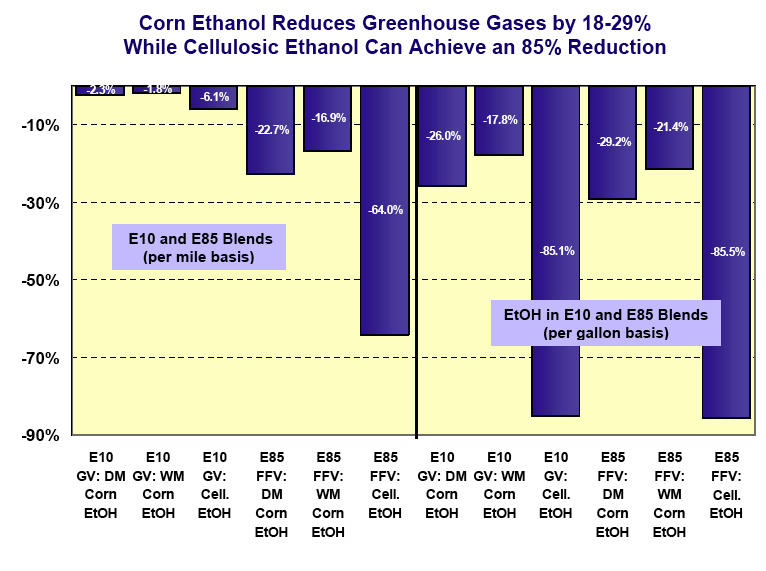
The figure below was used to illustrate the energy inputs used to produce and deliver a million British Thermal Units (Btu) of ethanol (EtOH) and petroleum gasoline to a refueling station.

As you can see, the fossil energy input per unit of ethanol is lower—0.74 million Btu fossil energy consumed for each 1 million Btu of ethanol delivered, compared to 1.23 million Btu of fossil energy consumed for each million Btu of gasoline delivered.

Another key finding he presented was that ethanol has a positive benefit in greenhouse gas (GHG) emissions reduction. On a per gallon basis, corn ethanol reduces GHG emissions by 18% to 29%, while cellulosic ethanol has an even greater benefit with an 85% reduction in GHG emissions.


Guide to abbreviations used:
BTU = British Thermal Units
Cell. = Cellulosic
DM = Dry Mill Process Ethanol
E10 = 10% Ethanol blend
E85 = 85% Ethanol Blend
EtOH = Ethanol
FFV = Flexible or Flex Fuel Vehicle
LPG = Liquified Petroleum Gas
NG = Natural Gas
RFG = Reformulated Gasoline
WM = Wet Mill Process Ethanol

August 13, 2005

R.E.N.E.W. L.A. - Jumpstarting Waste Reform in L.A.

Below are some excerpts from the progressive waste reform plan, R.E.N.E.W. L.A., proposed by Councilmember Greig Smith of the Los Angeles City Council (7/14/2005). To read the complete executive summary and plan, go to: "R.E.N.E.W. LA" Plan.

-------------------------

The City has a long way to go to create a new paradigm of sustainability, resource conservation, maximum material recovery, environmental protection, and renewable energy - a system in which the concept of waste itself is transformed to one of resource management.

It’s about Recovering Energy, Natural Resources, and Economic Benefit from Waste for Los Angeles - “RENEW LA”.

The goal of zero waste as defined in this plan is to reduce, reuse, recycle, or convert the resources now going to disposal so as to achieve an overall diversion level of 90% or more by 2025; and to leave for disposal only a small inert residual.

A Zero Waste philosophy includes a broad array of programs and policies within an overall framework of sustainability. Some of these goals, as voiced by the CIWMB (Sacramento-based California Integrated Waste Management Board) include:
• Promoting the management of all materials to their best and highest use
• Protecting public health and the environment
• Maximizing waste reduction and recycling
• Ensuring that products are made to be reused, repaired or recycled back into society
• Promoting front-end design efficiency in manufacturing to conserve virgin materials and reduce waste
• Harnessing the energy potential of waste by using new and clean technology to convert the material directly into “green” fuel, gas, or electricity

Conversion Technologies form a nexus between the solid waste industry and the power industry in that they “convert” portions of our wastestreams into renewable energy - thus simultaneously achieving waste diversion and green energy. In the City of Los Angeles, this creates a connection with the Department of Water and Power (DWP) and its aggressive Renewable Portfolio Standard (RPS) calling for 13% renewable energy by 2010 and 20% by 2017.

This blueprint relies on two key elements:
• the continuation, enhancement and growth of existing diversion programs; and
• the development of new CT facilities to process residual material still going to disposal (all CTs are non-combustion).

This plan makes no recommendations regarding the types of CT to be developed, but does highlight the five basic ones currently being evaluated and developed in Los Angeles and already in use in other cities and countries around the world. The CTs are:
• Gasification and Pyrolysis
• Anaerobic Digestion
• MSW Composting
• Autoclaving
• Fermentation

Not only does renewable energy decrease our demand for foreign and new supplies of domestic oil and other fossil fuels, it reduces greenhouse gases, and creates local jobs at the new facilities that would be constructed to generate this electricity.

The allure of fermentation CT in Los Angeles is that ethanol could be manufactured not from grain, but from the organic material in our wastestreams. This provides even more advantages in terms of greenhouse gas reductions and clean air benefits, plus generating home grown energy and the jobs and economic drivers that go along with it.

In California, ethanol is in huge demand with over 700 million gallons per year currently consumed in the State (and much of that, of course, in Los Angeles) under the MTBE additive replacement program. Currently, virtually all this ethanol is made from corn and comes from out of State. And this is at a very low percentage ethanol blend. If the blend were increased to 10% (E-10) or more (i.e. Brazil uses vehicles that burn an 85% ethanol blend (E-85)), the demand for the product would be almost unimaginable. In addition, hydrogen can be derived from ethanol; therefore, these fermentation plants can ultimately support the Governor’s “Hydrogen Highway” concept.

August 12, 2005

Waste Not... Before and After Product Use

In Wired News there is an interesting article about the advances in policy making and technology to reduce the amount of waste generated during the production processes of some major manufacturers (see "At Clean Plants, It's Waste Not" by Dan Orzech, August 10, 2005).

It's great that manufacturing companies are learning to create less waste in the production process as described in this article, but what about the reuse of the manufactured products after their effective life is over? The fact remains that in spite of heroic efforts by the recycling industry over the past few decades, most waste is still not recycled. In California that number is about 40 million tons of unrecycled waste per year - mostly paper, construction and demolition wastes, plastics, and other organics (CA Integrated Waste Management Board, 2004). Most of this ends up in land fills where the average cost to dump a ton of garbage in the U.S. rose from $8 in 1985 to $34 in 1995 (National Solid Waste Management Association). That's roughly $1.4 Billion in CA alone.

It is estimated that 75%-85% of the mass of this leftover waste could be converted to green power and heating, renewable fuels (ethanol and biodiesel), and green chemicals. These proven conversion technologies (CTs) include gasification, pyrolysis, thermal depolymerization, catalytic cracking, and hydrolysis/fermentation.

What is most needed to spur investment for implementation of CTs is regulatory reform like California's upcoming AB1090 bill. It would simply enable waste to be treated as fuel if it can be converted without violating existing environmental standards for residue and emissions toxicity. Diversion credits would also help communities and corporations invest in CTs.

To this point, it has been the recycling industry in the California that has been most resistant to change of the regulations - in spite of the fact that the CTs would only be used on leftover waste not currently utilized by recyclers. A lobby group headed by well-respected CA Senator David Roberti (Ret.) is collecting letters of support to present to the CA Integrated Waste Management Board in support of AB1090. Those interested should visit http://www.bioenergyproducers.org/ for the latest updates on this critical legislation.

August 4, 2005

Overdue for a Paradigm Shift

Our dependence on foreign fossil fuel resources is not going to be reduced any appreciable amount in the near future until a clean, renewable liquid fuel alternative is adopted. Ethanol is the obvious choice because: 1) it is already being used as a gasoline volume extender and a high percentage blend alternative, 2) cars that run on both ethanol and gasoline and any blend inbetween are already being manufactured by the major auto companies, 3) ethanol emissions are generally less harmful than gasoline, and 4) new feedstock for the fermentation process include agricultural, forestry, and urban waste - thus reducing environmental plagues while diversifying the range of siting options.

Not many people realize that Henry Ford built the Model T to run on ethanol - but at that time a strong case was made for refining abundant oil into gasoline because it was cheaper than ethanol to produce. So the oil liquid fuel paradigm took root and begat the gasoline refinery and distribution network - and cars were modified to run only on gasoline.

Sixty years later the world experiences a severe "oil crisis". Part of the world (Brazil) responded by adding ethanol back into play as a competitive alternative to oil - reducing dependence on oil and bringing a supportive infrastructure for distillation, distribution, and flex-fuel vehicle manufacture for blends of ethanol and gasoline. Today, Brazil exports ethanol, is not dependent on oil availability, has cleaner auto emissions, and robust demand for its sugar cane crops. A model for a liquid, non-fossil fuel paradigm shift and its positive cultural impact has been amply demonstrated.

Much as been made of the "peak oil" conundrum that bodes catastrophic consequences over the next few decades. Since 1976 there has not been one new gasoline refinery built in the U.S. - so it would seem that we are destined to experience a collapse of the gasoline paradigm. This will be exascerbated by the emerging demand for fossil fuel by China and India. At the same time, there have been over 85 ethanol plants built in the U.S. - based on the standard sugar fermentation process using corn kernels as feedstock. Equally important, distribution networks, ethanol flex-fuel and biodiesel vehicles, and a pro-ethanol enterprise culture has been developed - primarily in the farm states.

The time has come to spread the ethanol paradigm into urban areas using new technology based on gasification of plentiful sources of unrecycled biomass - urban, sewage, MSW, forestry, and agricultural waste. The technology exists and it is far cleaner, safer, and efficient than sugar fermentation. It will also help reduce the need for landfill sites (by about 80%), reduce field spreading of sewage, co-generate green power, and provide a smooth transition away from fossil fuels.

If anyone is interested in one reading about one good example of exciting bioconversion breakthroughs, visit http://www.brienergy.com.

July 6, 2005

Comments on Ethanol & National Security

Former CIA Director James Woolsey recently spoke at a press conference of the 25 x '25 Ag Energy Work Group about the national security importance of the energy paradigm shift away from fossil fuels toward renewable fuels like ethanol (Former CIA Director Woolsey on Ethanol & National Security). In response to Director Woolsey's presentation I would like to offer a few comments...

There are many aspects of national security that will be strengthened by a robust renewable energy commitment by this country. Addressing specifically bioconversion technologies that convert agricultural, forestry, and urban waste to ethanol:

1 - Markets for unsuccessful harvests (agricultural waste) as well as successful ones will secure farming incomes

2 - Farmers can rotate between crops without sacrificing bioenergy income

3 - Cooperative ownership of local production provides economic stability by decentralizing profit centers, increasing employment, and spurring local investment

4 - Competition between fossil fuels and renewables will keep fuel prices in check

5 - Consumer choice at the pump between various blends of gas/ethanol will insure a smooth transition in infrastructure and vehicle development

6 - Fewer greenhouse gas emissions bolster the air quality

7 - Waste conversion will reduce need for landfill

8 - Regional energy self-reliance will insure abundance

9 - Communities will save money from reduction of tipping fees

10 - Co-generated electricity will reduce dependence on fossil fuels


As a comparison, Brazil has a more secure energy policy than the United States when it comes to dependence on foreign liquid fuel supplies. As a net exporter of ethanol, it has demonstrated that a maturing ethanol infrastructure is achieveable and desireable, and that a wide variety flex-fuel automobiles from major car manufacturers are being marketed right now.

Emerging biomass conversion technologies holds the promise of regional energy self-reliance - the best defense against both foreign dependence and centralized corporate mis-management of the industry.

July 5, 2005

A BioConversion Technology that is Ready for PrimeTime

Imagine the following:
• the feedstock for fermenting ethanol is not just corn kernels but also corn husks, stalks, cobs, and/or even damaged harvests;
• the feedstock includes any agricultural crop or waste, forestry waste, urban waste (MSW), or even fossil fuel;
• waste conversion to ethanol results in a reduction of national landfill requirements by 85%;
• the fermenting process takes less than 1% (7 minutes) of the amount of time that sugar fermentation takes (36-48 hrs.);
• the conversion process co-generates excess green power with no toxic emissions.

A proven bioenergy process exists that uses bacteria to effect the conversion biomass to ethanol (see http://www.brienergy.com). With this process, bioconversion technologies promise to reduce waste, co-generate electricity, and reduce our dependence on foreign fossil fuels.

The fact that an infrastructure for its distribution already exists in many states and that the major auto manufacturers already produce flex-fuel cars internationally (i.e., Brazil) means that ethanol is a viable renewable liquid alternative to gasoline.

I would be interested in any comments readers have concerning the significance of this breakthrough and where they see it doing the most good.